A suction grab bar is placed on the shower tiles, we check that it holds, we give it a sharp pull. It seems solid. The next day, the bar has slipped a few millimeters. This scenario often appears in user feedback, raising a simple question: can we really rely on a suction grab bar to secure our bathroom?
Suction Grab Bar: A Balance Support, Not a Load-Bearing Support
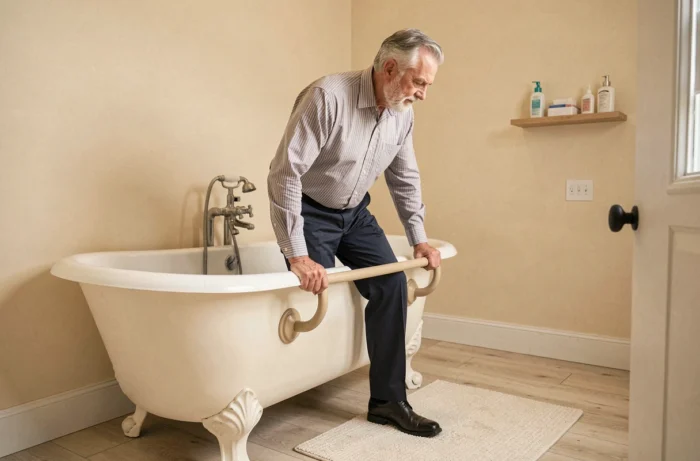
Confusion is common. One buys a suction bar thinking it will replace a wall-mounted bar. The instructions from some manufacturers and medical distributors, such as Axeo Medical Lyon, specify that these bars are intended for balance and not for weight transfer. They are suitable for a person who can stand independently and needs a support point to step over a bathtub edge or maintain stability in the shower.
In short, getting up from a seated position or hanging onto it exceeds their function. One model may display a maximum load of 40 kg, another 60 kg, but these values reflect product-specific testing conditions, not the ability to support the full weight of an adult. Before comparing numbers, it’s wise to read the exact wording of the instructions: does it refer to pull-off, static load, or simply assistance with balance?
To delve deeper into this distinction, the reviews on suction grab bars detail the actual limitations observed in use.
Wall Surface and Grout Joints: The Criterion That Changes Everything
You can buy the highest-rated bar on the market, but if the wall is not suitable, it won’t hold. This is the most underestimated point.
A suction cup needs a smooth, non-porous, and perfectly flat surface to create an airtight vacuum. Standard glazed tiles work well. In contrast, textured tiles, natural stone, painted walls, or porous coatings compromise adhesion from the start.
The most common trap concerns the joints between tiles. A suction cup placed straddling two tiles loses its seal at the joint, even if it appears thin. Some models with adjustable suction cups allow each fixing point to be positioned on a whole tile, reducing this risk. Before purchasing, measure the size of your tiles and compare it to the spacing of the suction cups.
Check Before Each Use
A suction grab bar is not a device that you install and forget. Manufacturers recommend checking the adhesion before each shower by pulling firmly on the bar. A visual depression indicator (colored dot or built-in indicator) is equipped on some models and signals when the suction cup begins to lose its vacuum.
Residual moisture, limescale, or soap deposits degrade adhesion over the weeks. Regular cleaning of the suction cups and the mounting surface, with clear water and no greasy residue, prolongs their hold. Feedback varies on this point: some users find stable support for months, while others need to readjust the bar weekly depending on the condition of their tiles.
Criteria for Choosing a Reliable Suction Grab Bar
You don’t choose a grab bar like you choose a bathroom accessory. Several technical criteria separate a usable product from a dangerous gadget.
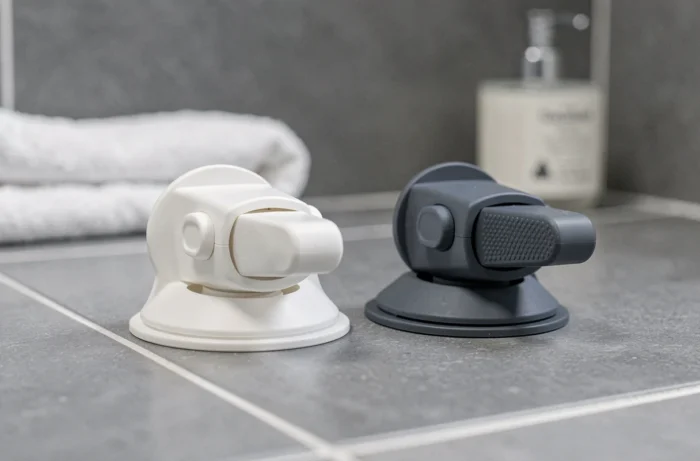
- Lever locking mechanism: pressure-only models offer less resistance than those equipped with a lever that actively compresses the suction cup against the wall. The lever also allows for a visual check that the bar is in the locked position.
- Appropriate grip diameter: a bar that is too thin slips under wet hands, while a bar that is too thick causes hand fatigue. A non-slip coating on the grip area enhances safety, especially with soapy hands.
- Length consistent with the space: a 30 cm bar is suitable for a point of support near an edge. To assist with lateral movement in a shower, you move to 40 cm or more. Measuring the available space prevents installing a bar whose suction cups fall on a joint or wall edge.
- Corrosion-resistant material: stainless steel or quality medical ABS plastic withstands permanent humidity without degrading. A low-quality material may crack or lose adhesion after a few months of exposure to hot water.
Suction Bar or Wall-Mounted Bar: When to Switch to Permanent Fixation
The suction grab bar has a legitimate use case: a temporary need (recovery, pregnancy, stay with a relative) or a situation where drilling the wall is impossible (rental, fragile tiling). For daily use by a person with reduced autonomy, wall mounting remains the reference in terms of safety.
A bar screwed into a load-bearing wall or fixed to an appropriate support does not depend on the quality of the tiling or humidity conditions. It supports the weight of an adult who is getting up or slipping. Installation requires drilling and sometimes the intervention of a professional, but there are financial aid devices available for adapting housing for seniors.
Combining Both to Secure Your Bathroom
You can install a fixed bar at the entrance of the shower or near the toilet, where the weight transfer is maximal, and complement it with a suction bar in a secondary location for balance. This combination covers both types of demands without multiplying the drill holes.
A well-chosen suction grab bar, placed on the right surface and checked regularly, fulfills its role as a balance aid. The risk begins when we ask it to do what it is not designed for: to support a fall or replace a fixed support.