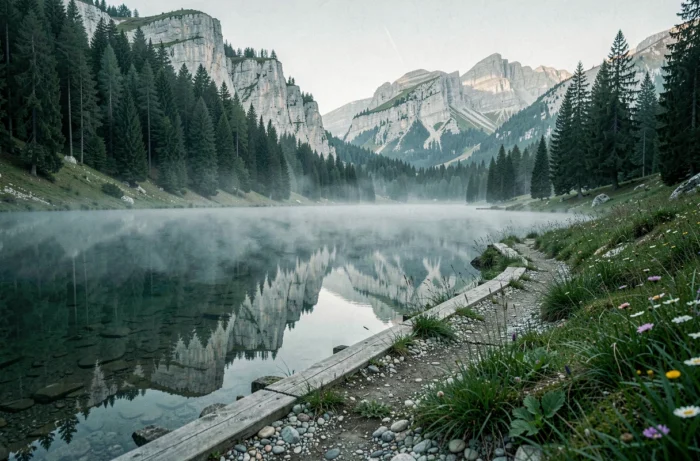
The Vercors massif is made up of karst limestone, which means that water seeps deep into the ground instead of remaining on the surface. Lakes are therefore rare, often artificial or nestled in particular geological configurations. This rarity makes each body of water all the more remarkable for those seeking a water getaway less than an hour from Grenoble.
Karst Geology of the Vercors and Rarity of Surface Lakes
The limestone that makes up most of the Vercors dissolves under the action of rain and runoff. Water penetrates the rock, carves out underground galleries, and feeds invisible rivers at the bottom of sinkholes. On the surface, natural basins capable of retaining a permanent body of water are exceptional.
The few lakes found on the plateau are mostly hilltop reservoirs, excavated by humans to store melted snow or supply the ski resort’s snow cannons. Lake des Prés, above Villard-de-Lans, is a typical example: its existence is due to a development related to the Villard-Corrençon ski area.
The gorges represent another aquatic face of the massif. The gorges of Bruyant, accessible from Lans-en-Vercors, or those of Méaudret, near Autrans, offer routes where water flows on the surface over short stretches. They are not lakes, but these sites allow for a refreshing dip in a wild and enclosed setting.
By expanding the perimeter to the foothills of the massif and neighboring valleys, the options increase. Exploring the lakes of Vercors near Grenoble often involves descending towards Matheysine or following the Drac to find larger bodies of water, such as Lake Monteynard or those on the Matheysine plateau.
Swimming Areas, Wild Lakes, or Activity Sites: Criteria for Choice
Not all bodies of water are equal depending on what one is looking for. Before loading the trunk, three criteria should be clearly established.
Supervision and Water Quality
A lake classified as good quality water is not necessarily supervised by lifeguards. The health classification, available in public databases, provides information on the bacteriological quality of the water, not on the presence of a rescue station. This distinction changes the game for families with young children.
Developed sites like the Bois Français leisure center (Lake Taillefer) offer supervised swimming during the summer season, designated areas, and organized water activities. Lake Sautet also provides a supervised beach in summer.
In contrast, Lake Laffrey, despite its emerald waters and tree-lined beaches, remains a site of unsupervised swimming. The responsibility lies entirely with the swimmer.
Risks of Wild Swimming
Undeveloped sites do not necessarily undergo regular health checks. After heavy rains, runoff can quickly degrade water quality by carrying sediments, organic matter, or agricultural pollutants. The absence of signage regarding depths, currents, or depth adds a physical risk to the health risk.
- Check health advisories and any swimming bans just before departure, not the day before
- Respect on-site signage, even if it seems excessive in good weather
- Prefer the warmest hours to limit thermal shock in mountain waters, which are often cold even in mid-summer
Water Activity Sites or Aquatic Hiking
Lake Monteynard stands out from other bodies of water due to its use. More than a swimming spot, it is a site combining water activities and hiking, with suspended walkways above the gorges of Drac and Ébron. If the goal is an active outing rather than a lazy afternoon by the water, Monteynard is a more suitable choice than the beaches of Laffrey or Bois Français.
Hiking to the Reservoirs of the Plateau: Lake des Prés and Gorges of Bruyant
For those who prefer to earn their water point, the Vercors plateau offers hiking routes leading to hilltop reservoirs or cool gorges.
Lake des Prés in Villard-de-Lans is accessible via several paths. The quickest route goes through the cable car and then descends on foot. The most interesting approach starts from the Clots parking lot, above the Glovettes, and traverses a wilder environment before reaching the reservoir.
The gorges of Bruyant, from Lans-en-Vercors, offer a shaded path where water flows between narrow limestone walls. It is not a lake, but the thermal contrast with the plateau is striking. The gorges of Méaudret, accessible from Autrans, provide a similar atmosphere with a path along the watercourse.
These hikes remain short and accessible to families, provided that suitable shoes for rocky and sometimes slippery paths near the water are worn.
Lakes of Matheysine and Trièves: Expanding the Radius from Grenoble
By going beyond the strict limits of the Vercors, Matheysine concentrates several lakes within an hour of Grenoble. Lake Laffrey and Lake Petichet, located on the same plateau, offer distinct atmospheres: Laffrey attracts with its beaches and deep waters, while Petichet enchants with its panorama facing Obiou.
Lake Sautet, between Trièves and Beaumont, combines a spectacular setting facing Obiou with varied activities: canoeing, via ferrata nearby, supervised beach. It is one of the few sites in the area that combines supervised swimming with a sporting dimension.
- Lake Laffrey: emerald waters, unsupervised swimming, easy access from the N85
- Petichet: calm, mountain panorama, less frequented than its neighbor
- Lake Sautet: supervised beach in summer, water and sports activities, marked alpine landscape
The choice between these destinations depends on the level of comfort sought. A day at Sautet with children offers a more secure setting. A getaway to Laffrey is better suited for independent swimmers who accept the lack of supervision.
The rarity of natural lakes in the Vercors forces one to broaden their perspective towards these peripheral valleys. Ultimately, it is this geological constraint that gives each body of water in the Grenoble area its unique character, between high-altitude reservoirs, enclosed gorges, and large dam lakes backed by the Alps.