When hair density decreases after the age of 60, the choice of a haircut is no longer just about aesthetics. It is about visually compensating for thinning hair that affects, according to a recent prevalence study, just over one in two women between the ages of 50 and 65.
Fine hair, widening part, more visible scalp along the midline of the skull: the parameters to consider are specific. It is essential to know which haircut actually affects the perception of volume and which one might exacerbate the problem.
Pixie, short bob, mid-length layered: comparison of cuts for fine hair after 60
Not all short cuts produce the same effect on thinning hair. Length, the presence or absence of layers, and the management of the top of the head radically change the outcome.
| Type of Cut | Length | Effect on Volume | Thinning Area Covered | Maintenance |
|---|---|---|---|---|
| Voluminous Pixie | Very short (sides and nape), longer on top | Concentrates volume at the crown | Midline, temples | Touch-up every 4 to 6 weeks |
| Short Layered Bob | Chin or above | Movement and texture, lightens the ends | Face contour | Touch-up every 6 to 8 weeks |
| Mid-Length Layered with Bangs | Shoulders or slightly above | Distributes mass, adds movement | Forehead and hairline | Regular maintenance cut, frequent blow-drying |
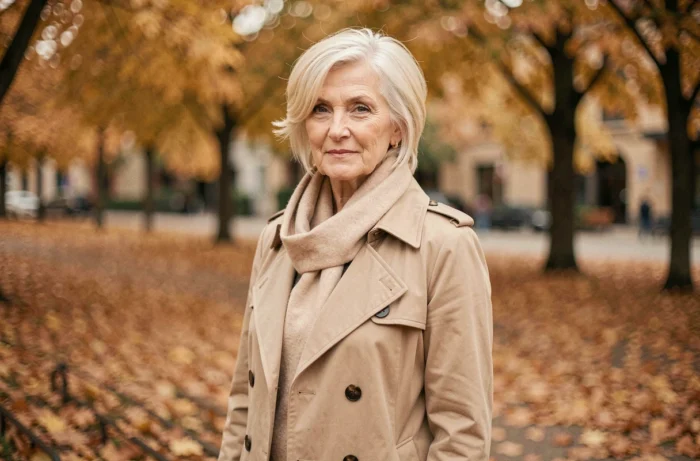
The voluminous pixie works particularly well when the loss of density is concentrated on the top of the head. Shortening the sides and nape removes the weight that pulls the hair down, and the length kept on top creates a mass effect where the scalp is most exposed.
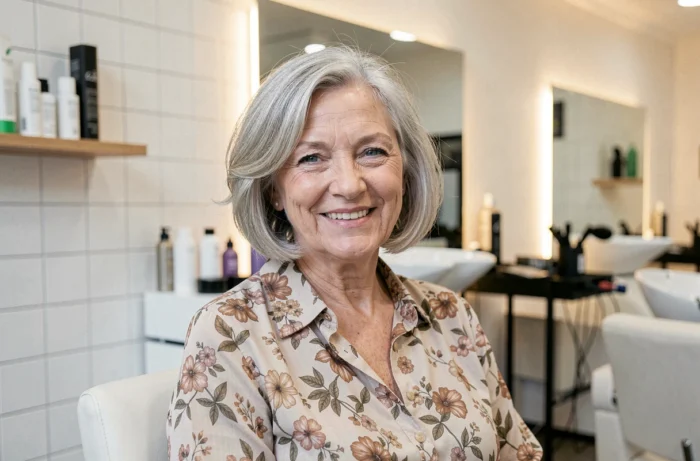
The short layered bob is more suitable for oval or heart-shaped faces. The layers lighten the ends, avoiding the flat effect produced by a straight cut on fine hair. Choosing a cut for fine and thinning hair in women over 60 that suits the face shape remains the first criterion to check before considering trends.
Bangs and Texture: Two Often Underestimated Levers for Thinning Hair
Bangs are one of the most effective tools for hiding a receding hairline or thinning hair. A curtain bang, parted in the center and tapered on the sides, does not overwhelm the face and creates an illusion of density in the frontal area.
On the other hand, a thick straight bang should be avoided when the hair overall lacks substance. It takes away volume from the rest of the cut and can accentuate the disproportion between the top and the sides.
Texture and Movement Rather Than Length
On fine hair, texture provides more perceived volume than length. Long, straight hair appears flatter than short, slightly wavy hair. The principle of the voluminous pixie relies on very short on the sides and back, with more length on top, precisely to play on this contrast of textures.
Cutting techniques that create movement without further thinning the hair should be prioritized:
- Layered cuts that give bounce without removing mass from the ends
- Light thinning only on the densest areas, never on the already thinning top of the head
- Blow-drying upside down, which lifts the roots and sets volume at the base of the hair
Hair Density After 60: What a Cut Alone Cannot Compensate For
The loss of density at this age is not solely a matter of hairstyle. The aforementioned prevalence study shows a counterintuitive result: after statistical adjustment, the factor most associated with female alopecia is a BMI of 25 or higher, indicating overweight. Neither menopause nor its duration remain significantly correlated once this parameter is taken into account.
This data changes the perspective. Adapting one’s haircut is an immediate and visual response, but it does not address the cause. A hair assessment with a dermatologist can identify whether the loss is due to female androgenetic alopecia, a deficiency (iron, vitamin D), or a metabolic factor.
The Value of a Volumizing Cut Without Proper Care
A perfectly executed pixie will lose its effect in a few days if the hair is too fragile to hold the shape. Care conditions the hold of the cut, not the other way around.
- Volumizing shampoos without silicone prevent weighing down the hair and flattening it against the scalp
- Light leave-in treatments protect the fiber without greasing it
- Texturizing sprays applied at the roots create substance where density is lacking
- Spacing out washes (every other day or every three days) preserves the natural sebum that slightly thickens the hair
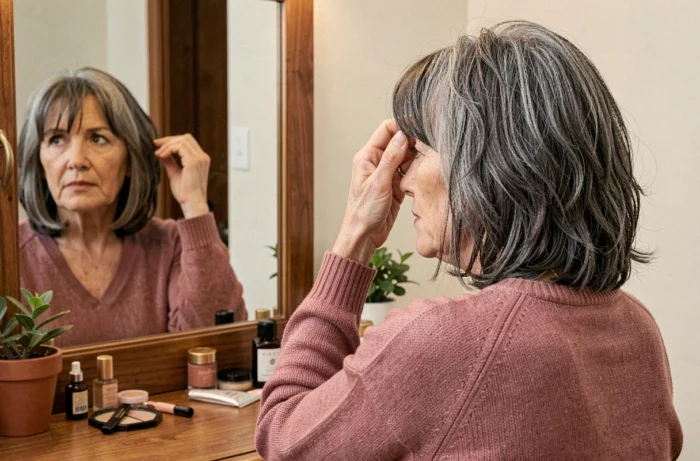
White Hair and Short Cuts After 60: A Unique Texture Parameter
White hair does not have the same structure as pigmented hair. It is often thicker individually, drier, and coarser. On a short cut, this rigidity can be an advantage: white hair holds volume better naturally than fine, porous colored hair.
Embracing white hair on a pixie or a textured short bob also avoids the damage associated with repeated coloring, which gradually thins the hair fiber. Permanent dyes, by repeatedly lifting the hair cuticle, contribute to long-term density loss.
For women who wish to maintain color, partial balayage or targeted highlights limit chemical exposure to the most visible areas without treating the entire head of hair.
The choice of a cut for fine and thinning hair is based on three measurable parameters: the area where density loss is most pronounced, the face shape, and the natural texture of the hair (pigmented or white). The rest, trends and personal preferences, come after these technical criteria.