
A colleague returns from Costa Rica with spectacular photos. You think it would be the perfect destination, start looking at flights, then realize the outbound journey takes more than ten hours, the rainy season falls right during your planned time off, and the budget is already spiraling before you’ve even booked accommodation. Costa Rica wasn’t the problem. The problem was starting with the image instead of the constraints.
Choosing a destination to get away and enjoy new experiences starts with working backwards: first, identify what’s non-negotiable (trip length, season, travel time), then look for a place that fits—not the other way around.
Travel time and getting around: the filter no one applies first
We often compare two destinations based on flight prices or beautiful scenery. But the factor that really shapes the experience is the time spent in transit compared with the time spent at your destination.
A four-day long weekend with a nine-hour flight and a six-hour time difference leaves you with just two usable days. Spend the same amount of time taking a three-hour train ride to a European city, and you’ll have three full days, without jet lag.
The impact of a trip often depends more on the journey than on the scenery you choose. Air travel takes a particularly heavy toll, both on your budget and on your energy. When you’re torn between a faraway destination and a closer getaway, asking how you’ll get there and get around once you arrive can quickly rule out options that look ideal on paper but break up your trip.
You can explore a range of destinations by comparing travel options on https://www.quelque-part.net, making it easier to see exactly how long and complicated the journey will be before you commit.
A good rule of thumb: focus on a smaller area once you arrive rather than planning a scattered itinerary. Visiting three cities in ten days, with four-hour journeys between each stop, means spending a third of your trip on a bus or in a rental car. A longer stay in one place can offer an immersion that hopping between destinations simply can’t.
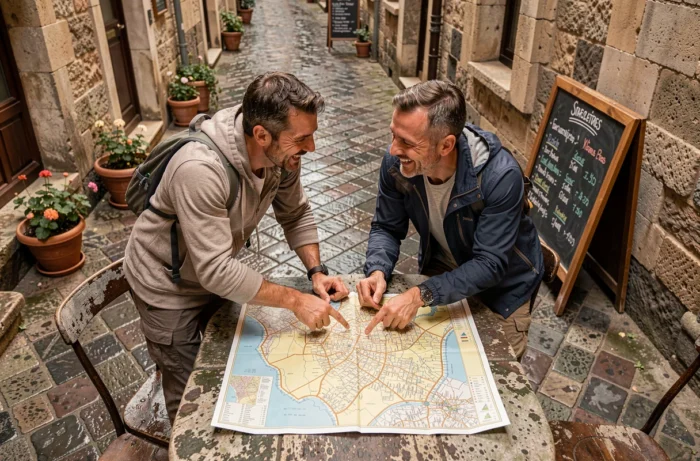
Season and tourist crowds: decide when to go before deciding where
The season can be just as important as the destination itself. Everyone thinks of Japan in April for the cherry blossoms. The result: accommodation prices at their peak, crowded temples, and queues everywhere. Visit the same country in November, and you’ll find comparable autumn colors in Kyoto’s gardens, with far fewer visitors.
Comparing the same destination in peak season and off-season can completely change your assessment. The weather is often still pleasant during shoulder seasons, while tourist numbers drop significantly. For countries with monsoon seasons or distinct dry seasons, checking ahead can help you avoid unpleasant surprises (closed roads, shut parks, canceled activities).
Three things to check before settling on your travel dates
- Average weather conditions for your chosen month in the specific area you’re visiting—not just the country’s national average
- Local school holiday dates and national holidays, which can drive up visitor numbers even during the theoretical low season
- Whether the sites or activities you’re interested in are open (some nature parks, hiking trails, and ferry routes close for several months each year)
This research takes an hour, but it can save you from discovering once you arrive that half your planned itinerary is inaccessible.
Travel budget: look beyond the airfare
The usual approach is to look for the cheapest flight, then estimate everything else. That skews the calculation from the start. The real cost of a trip comes down to accommodation, food, and local transport, not the round-trip ticket.
A rock-bottom flight to a Northern European capital may seem like a bargain, but restaurant meals, public transport, and hotel stays can sometimes cost twice as much as they would in a Southern European city, even with a slightly more expensive flight. The difference in airfare can be wiped out in just two days of everyday spending.
Set a daily budget for each country
Instead of working with a vague overall budget, it’s clearer to estimate a daily amount that covers accommodation, two meals, local transport, and one activity. This amount varies considerably from one country to another, even within Europe. Portugal and Greece, for example, are still much more affordable day to day than Scandinavia or Switzerland, for a similar level of comfort.
For destinations outside Europe, checking the current entry requirements is also part of calculating the real cost. For example, ETIAS (the travel authorization system for the Schengen Area) is still not in operation as of November 2026, and no applications are being accepted at this time. Travelers who will be affected by these future rules should check the official status before departure rather than relying on launch dates announced by third-party websites.

What you want to experience: start with the activity, not the map
We often open a world map and hope inspiration will strike. The opposite approach is what works. Start with the specific experience you want (hiking at altitude, discovering local cuisine, spotting a particular type of wildlife, or scuba diving), and you’ll immediately narrow your options to a handful of suitable destinations.
- If you want to hike in the mountains and stay in staffed mountain huts, consider the Alps, the Dolomites, or the Pyrenees rather than a Himalayan trek that requires three weeks and a substantial budget
- If you’re interested in culture and smaller cities, look at Porto, Ghent, or Ljubljana rather than overcrowded capitals
- If you’re looking for nature and wildlife you can enjoy without an expedition, consider Iceland, the Azores, or coastal Norway, depending on the season
The best destination for you isn’t the one that looks most spectacular on Instagram, but the one that lets you enjoy the activity you’re after, with a realistic journey, favorable conditions, and minimal logistics once you arrive. A trip where you spend three full days doing what you came for will leave a stronger impression than a ten-day tour where you rush through every stop between transfers.
Ultimately, choosing a destination comes down to applying three filters in the right order: travel time that fits the length of your stay, a season that offers the conditions you’re looking for, and your daily budget at the destination. The country comes next, as a logical result of those constraints—not as the starting point.