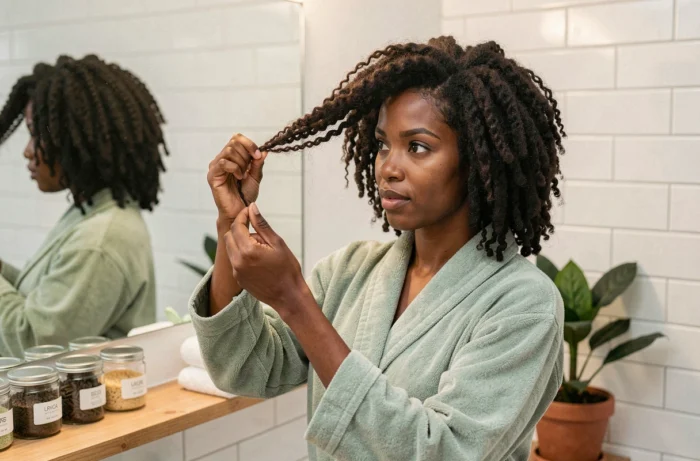
Your hair gets greasy the day after shampooing, or, on the contrary, feels tight and breaks at the slightest brushstroke. The “miracle” product a friend recommended made no difference. The problem rarely lies with the product itself; it starts with the initial diagnosis. Identifying your hair type before choosing a treatment can save you months of trial and error and unnecessary spending.
Texture, thickness, porosity: three factors to distinguish first
Most hair guides mix up hair shape (straight, wavy, curly, coily) with its thickness or surface condition. Yet these three factors are independent. Curly hair can be fine or thick, porous or not. Confusing shape with thickness leads to choosing the wrong hair care products.
Hair shape depends on the cross-section of the hair follicle beneath the scalp. The rounder the follicle, the straighter the hair grows. The flatter it is, the more the hair fiber coils around itself. This is a genetic trait that remains stable over time.
Thickness, on the other hand, is measured on a single strand of hair. Pinch a strand between your thumb and index finger: if you can barely feel it, it’s fine. If you can clearly feel it, it’s thick. This makes all the difference, because a treatment that’s too rich can weigh down fine hair and eliminate its volume.
Then there’s porosity, a less familiar but crucial factor. It refers to the hair fiber’s ability to absorb and retain water. This article on hair types and the right care for each explains how it works. To test your hair at home, place a clean strand (with no product on it) in a glass of water. If it floats after a few minutes, its porosity is low. If it sinks quickly, its porosity is high.

At-home test to determine your hair type accurately
Have you noticed that your hair behaves differently depending on when you wash it? That’s normal: sebum, product residue and ambient humidity can all affect what you see. For a reliable diagnosis, there’s one method that works.
Wash your hair with a gentle shampoo, without conditioner or leave-in treatment. Gently blot it with a cotton fabric (an old T-shirt works better than a terry towel, which creates friction). Let it air-dry without touching or styling it.
Once your hair is dry, look at three things:
- Its natural shape when left alone: does it fall perfectly straight, form S-shaped waves, defined curls or very tight coils? This determines your shape category (type 1 to 4).
- Its overall volume: hair that looks flat and close to the scalp often indicates fine strands, while ample volume suggests thicker strands or high hair density.
- How it feels along the lengths: hair that feels rough and coarse may indicate high porosity or a lack of moisture, while hair that feels soft but limp often lacks protein.
This three-part check takes less than five minutes. It gives you a much more reliable starting point than any online quiz, which can’t assess your actual hair thickness or porosity.
Choose hair care based on your diagnosis
Once you’ve identified these three factors, choosing the right products becomes straightforward. Here are the most common combinations and what they mean in practice.
Fine hair with low porosity
This hair type doesn’t absorb treatments easily and gets weighed down quickly. Choose lightweight formulas: sprays, fluid lotions and water-based serums. Avoid masks made with shea butter or heavy oils on the lengths. Apply shampoo to the scalp, not the ends, as recommended by the American Academy of Dermatology (AAD). The lather that runs down your hair as you rinse is enough to clean the lengths.
Thick, curly or coily hair with high porosity
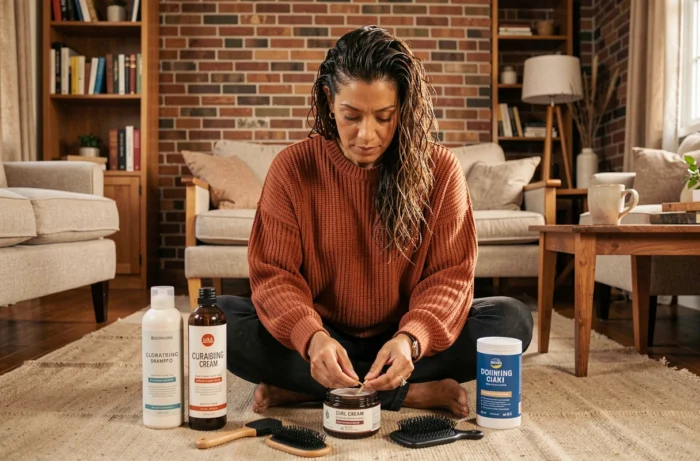
The hair fiber loses moisture very quickly and needs rich treatments applied in layers. The method involves layering a hydrating product (water- or aloe vera gel-based), followed by a nourishing product (plant oil), then a sealing product (butter or thick cream). This is the principle behind hair layering.
The AAD recommends detangling textured or very curly hair while it’s still damp, using a wide-tooth comb. Pulling on dry curls breaks the hair fiber and causes frizz.
Oily scalp and dry lengths
This very common combination often leads people to wash their hair less frequently. The reality is more nuanced. How often you wash your hair depends on the condition of your scalp, not on a fixed rule. A scalp that produces a lot of sebum needs regular cleansing to prevent dead skin cells and residue from building up. Spacing out washes as a matter of principle can make itching or dandruff worse.
The solution: apply a gentle shampoo only to the scalp, then use a lightweight hydrating treatment on the lengths and ends.
When hair care isn’t enough: signs you shouldn’t ignore
Have you noticed more hair falling out than usual, or that it’s gradually getting thinner? Persistent hair loss isn’t always caused by an unsuitable routine. The AAD recommends seeing a dermatologist if hair loss has lasted for several weeks, as the causes may be hormonal, nutritional or medical.
Likewise, if your scalp itches, becomes red or flakes despite using gentle products, seek medical advice. No mask can treat seborrheic dermatitis or scalp psoriasis. Hair care has its limits, and recognizing them can save you from wasting time on cosmetic solutions when the problem is dermatological.
Precisely identifying your hair’s shape, thickness and porosity is the most practical starting point for building an effective hair care routine. The glass-of-water test and observing your hair after washing it without products cost nothing and take just a few minutes. Start there before buying anything.