
When an IT team spends more time negotiating an electrical connection for its servers than training a language model, it is clear that the technological trends of 2026 have changed in nature. Current bottlenecks are found in energy, compliance, and the ability of organizations to absorb what the tools already allow.
Energy Consumption of AI: The Wall That Roadmaps Ignore
Recent technology assessments align the promises of generative models, but energy constraints are already slowing deployments. According to projections from the McKinsey Technology Trends Outlook, U.S. AI data centers could consume as much electricity as California by 2030. Over 2,500 GW of energy projects are waiting to be connected to the grid.
For a company considering bringing its inference workloads in-house, the question is no longer the cost of the GPU. It is the availability of electrical transformers, high-voltage lines, and long-term supply contracts. Detailed analyses of these infrastructure constraints that condition companies’ technological choices can regularly be found on the tech section of the Athomedia website.
IT managers planning an AI scale-up in 2026 must integrate an energy audit from the scoping phase. Without guaranteed access to electricity, the best model in the world remains just a line in a PowerPoint.
AI Agents in Business: The Gap Between Adoption and Financial Return
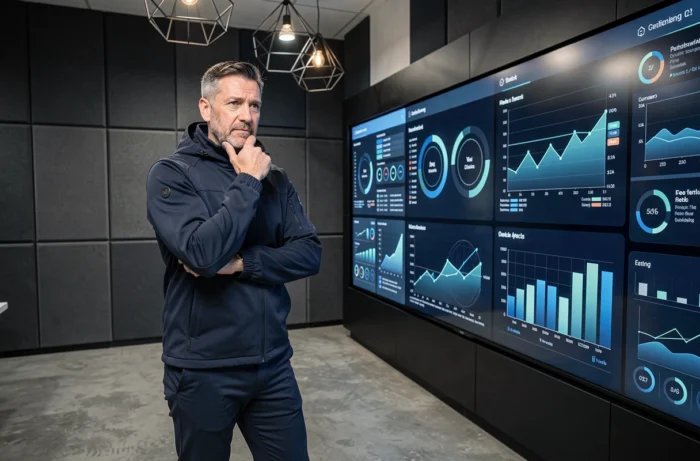
The adoption of AI agents is progressing rapidly in companies of all sizes. The problem is that only a minority report a positive impact on operational results.
The explanation rarely lies in the technology itself. What holds back progress is the integration into existing processes. A conversational agent connected to a CRM is useless if customer records are poorly filled out, if no one has redefined the responsibilities between the agent and the human, or if quality control still relies on a shared spreadsheet.
Companies that derive measurable value from their AI agents share three characteristics:
- They reorganized workflows before deploying the tool, not after
- They measure a specific business indicator (processing time, first contact resolution rate) rather than a volume of interactions
- They appointed an operational manager for the agent, distinct from the technical team that built it
Without this discipline, the AI agent becomes a recurring cost without return. The real issue in 2026 is not adoption but reorganization around the tool.
Digital Compliance in Europe: From Regulatory Text to Ground-Level Configuration
The European AI Act, the Data Act, and the strengthening of cybersecurity requirements (NIS 2 directive) create a regulatory stack that technical teams must translate into concrete configurations. We are no longer talking about abstract legal monitoring: it is necessary to document training datasets, trace automated decisions, and prove compliance during an audit.
For SMEs and mid-sized enterprises, this represents a new burden. Feedback on this point varies according to the size of the organization and the sector, but the lack of technical documentation has become a direct business risk, not just regulatory. A large client demanding AI Act compliance in its tenders effectively eliminates suppliers that have not structured their AI governance.
Priority actions on the ground:
- Map every use of AI in production and classify it according to the risk levels defined by the AI Act
- Establish a traceability register for automated decisions, even for low-risk cases
- Train business teams (not just developers) on documenting biases and limitations of the models used

Post-Quantum Security: Anticipating Cryptographic Migration
The topic may seem distant, but cryptographic migration is being prepared now. The so-called “harvest now, decrypt later” attacks involve collecting encrypted data today to decrypt it when a sufficiently powerful quantum computer becomes available. Sensitive data transmitted in 2026 is therefore already exposed if its lifespan exceeds a decade.
In Europe, regulators are gradually integrating these requirements into existing cybersecurity frameworks.
The inventory of cryptographic assets is the first operational step: identifying which protocols, certificates, and libraries are used in the infrastructure, then assessing which will need to migrate as a priority. Embedded systems and industrial IoT devices, often difficult to update, represent the most critical cases.
Technological Sovereignty and Hybrid Cloud: A Structuring Arbitration
The choice of hosting is no longer a purely technical decision. Sovereign cloud offerings (S3NS, Numspot) respond to a growing demand from regulated sectors (health, defense, financial services) that can no longer store certain data with providers subject to extraterritorial jurisdictions.
On the ground, the hybrid cloud is emerging as the dominant operational compromise. Sensitive workloads are kept on a sovereign or private infrastructure, while hyperscalers are used for unregulated processing that requires elasticity. The practical challenge is interoperability between these environments: orchestration of containers, consistency of security policies, unified identity management.
The technological trends of 2026 converge towards the same conclusion. The raw performance of tools (AI models, cloud capabilities, computing power) far exceeds what most organizations know how to absorb. Available energy, process maturity, regulatory compliance, and cryptographic security set the real limits of deployment.