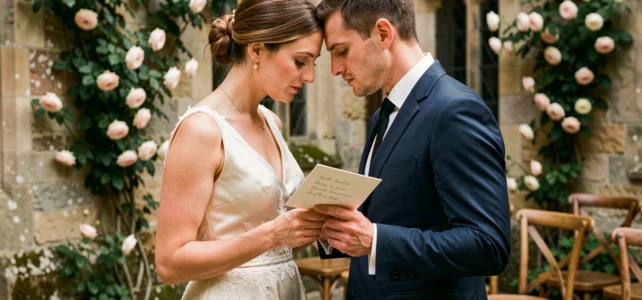
Reading a text aloud in front of the assembly on the wedding day remains one of the most memorable moments of the ceremony. Finding the right words, those that convey a couple’s story without falling into banality, requires real work in selection. Here is a practical approach to choosing and preparing love texts that will sincerely touch your guests.
Custom love texts or literary quotes: what works orally
You may have noticed that a poem read aloud can sound very different from its silent reading version? This is the first trap to avoid. A beautiful alexandrine on paper can sometimes become opaque in front of an assembly fatigued by the July heat.
Custom texts, built from the couple’s daily life (nicknames, places, domestic rituals), are gaining ground over copied poems. The reason is simple: a text rooted in lived experience is immediately understood when spoken. The assembly does not need to decode a metaphor; they recognize a scene, a memory, a shared emotion.
This does not mean that literature should be banned. An excerpt from Victor Hugo or Jacques Brel can be moving, provided it is selected for its oral clarity. The most beautiful love texts for weddings often combine a short quote with a few personal sentences that connect it to your story.
Favor passages of less than two minutes to read. Beyond that, the assembly’s attention drops significantly, especially outdoors.
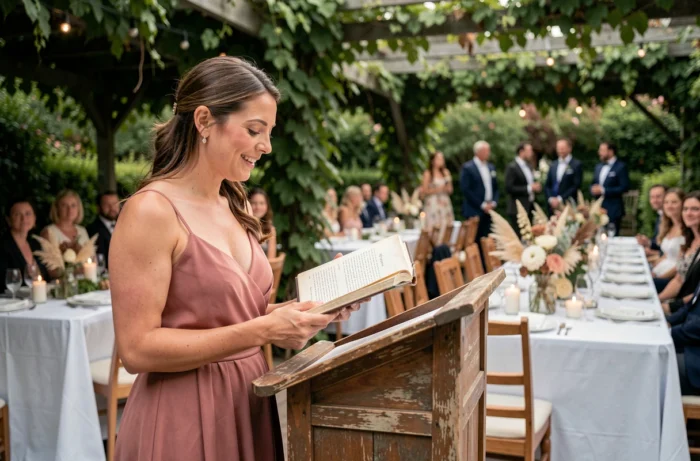
Building a ceremony text like a couple’s narrative
Officiants of secular ceremonies and wedding planners now use a precise method: before writing, they collect anecdotes through a detailed questionnaire. First meeting, shared hobbies, funny mishaps, pivotal moments. The love text then becomes a biographical narrative of the couple, not a succession of pretty phrases.
This approach structures the text in four parts:
- A personal introduction that sets the context (who is speaking, what is their connection to the couple)
- The couple’s story told through two or three concrete scenes, with details that loved ones will recognize
- A moment of humor or lightness, which eases emotional tension and prevents the text from becoming monotonous
- An emotional conclusion, looking towards the future, that connects the shared past to the promise of the day
Why does this structure work so well? Because it follows the natural rhythm of a conversation. Laughter precedes emotion, and emotion lands stronger after laughter.
The common mistake of overly literary text
Stringing together three poems by Ronsard, Éluard, and Prévert during the ceremony creates a catalog effect. Each text, no matter how beautiful, loses its impact when drowned in a series. It’s better to have a single well-chosen literary excerpt surrounded by personal words.
Adapting the love text to the type of ceremony
A text read at the town hall does not follow the same constraints as a text read during a secular outdoor ceremony. The setting changes everything.
At the town hall, time is limited. The civil officer follows a precise schedule, and personal readings fit into a short slot. A civil wedding text benefits from being dense and brief, between five and ten sentences. A quote followed by two personal lines is enough to mark the moment.
In a secular ceremony, the freedom is total. This is where narrative texts make the most sense. You can assign different readings to several loved ones, each bringing their perspective on the couple. The opposite trap then awaits: too many readings kill the readings. Three well-distributed texts are better than seven stretched-out interventions.
Religious ceremony: a framework to respect
In a Catholic religious wedding, the texts read during the liturgy are chosen from a defined corpus (biblical readings, psalms). Personal or literary love texts find their place outside the liturgy, often at the entrance or exit of the church, or during the reception.

Personal vows and promises: writing what withstands the test of time
Wedding vows differ from the love text read by a loved one. Here, it is the groom or bride who speaks directly to the other. The register changes: we move from narrative to promise.
An effective vow relies on concrete details. “I promise to always make you coffee before you get up” resonates more than “I promise to love you for eternity.” Promises rooted in daily life resonate more than abstract declarations.
To avoid the blank page syndrome, start by listing five moments when you knew this person was the one. Not grand events, but details. The way they laugh, a habitual gesture, a repeated phrase. These micro-scenes form the raw material for sincere vows.
- Read your vows aloud at least three times before the big day, timing yourself
- Ask a trusted loved one to listen to them to check for clarity and rhythm
- Prepare a printed version in large format, readable even with trembling hands
A love text for a wedding is not judged by its literary beauty, but by its emotional accuracy. The words that make the assembly cry are rarely those of a great author. They are the ones that precisely tell what two people are experiencing together. The most beautiful text of your ceremony is probably the one you have not yet written.