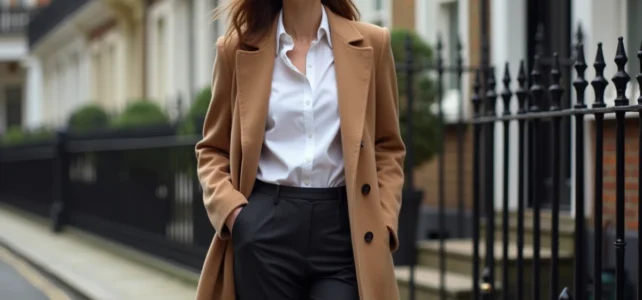
A trench coat worn with the collar up in the London rain, a tweed jacket thrown over the shoulders for a weekend in the countryside, a fine wool sweater tucked into pleated trousers: these images repeatedly come to mind when discussing British fashion. What strikes one about English elegance is not the abundance of pieces, but how each finds its place in a wardrobe designed to last.
Fit and sobriety: the two pillars of the British wardrobe today
Have you ever noticed that an English suit doesn’t have the same effect as an Italian suit, even in the same color? The difference rarely lies in the fabric. It comes from the cut.
British tailoring favors a structured shoulder and a slightly defined waist. The silhouette remains straight, without the Neapolitan roundness or the relaxed Scandinavian volume. This construction choice gives the garment its shape, even after years of wear.
The contemporary rule that the British follow can be summed up in one sentence: neutral base with a single point of interest per outfit. In practical terms, a structured gray or navy trouser, a simple shirt, and then just one element that draws the eye, whether it’s a texture (tweed, corduroy), a color (fir green, deep burgundy), or a volume (oversized coat). This principle prevents accumulation and gives British style that effortless elegance.
To explore this universe through pieces true to English codes, British & Co offers a selection that well illustrates this philosophy of durable and refined clothing.

Noble materials of English style: tweed, wool, and cotton
British chic relies as much on what you touch as on what you see. Before choosing a color or a pattern, the important question is about the fabric.
Why tweed remains a British fashion reference
Tweed is not a decorative fabric. It is a tightly woven wool cloth, originally designed to withstand the wind and moisture of the Scottish and Irish countryside. Its irregular texture gives it a visual grain that smooth industrial fabrics do not replicate.
Good tweed improves with age: it develops a patina, softens, and retains its structure. It is the exact opposite of a disposable garment. It is found in country jackets, vests, and certain three-quarter coats worn both in the city and in the countryside.
Other materials to know
- Fine merino wool, used for sweaters and scarves, provides warmth without bulk. It can be worn directly against the skin or as a mid-layer under a jacket.
- Oxford cotton forms the basis of the English shirt. Its slightly textured weave distinguishes it from smooth poplin and gives it a more casual character, suitable for everyday wear.
- Cashmere, reserved for investment pieces (sweaters, scarves), remains the symbol of discreet British refinement.
- Corduroy, often in trousers or jackets, adds a touch of English countryside without falling into the suit category.
Building a British wardrobe for men or women: the essential pieces
Rather than accumulating seasonal trends, the English approach is to invest in a few versatile pieces. Three of them deserve special attention.
The trench coat, the backbone of British style
Designed to protect from the rain, the trench remains the most versatile piece in the English wardrobe. It works over jeans as well as over a suit. Its mid-length cut structures the silhouette without weighing it down. Beige remains the classic choice, but navy or khaki versions offer more discretion for everyday wear.
The tweed or structured wool jacket
Worn open over a turtleneck or buttoned up with a scarf, the tweed jacket bridges the countryside and urban styles. It is a great alternative to a classic blazer when looking for character without formality.
The boots and shoes: the detail that anchors everything
In British fashion, shoes are never a secondary accessory. Leather Chelsea boots, thick-soled derbies, or rubber country boots (the Wellington model remains a reference) immediately signify belonging to the English wardrobe. Well-maintained shoes are worth more than an expensive garment worn with tired sneakers.
Colors and patterns of English fashion: beyond tartan
Tartan is the pattern that is spontaneously associated with Great Britain, but to reduce it to that would be to overlook the true palette of British style.
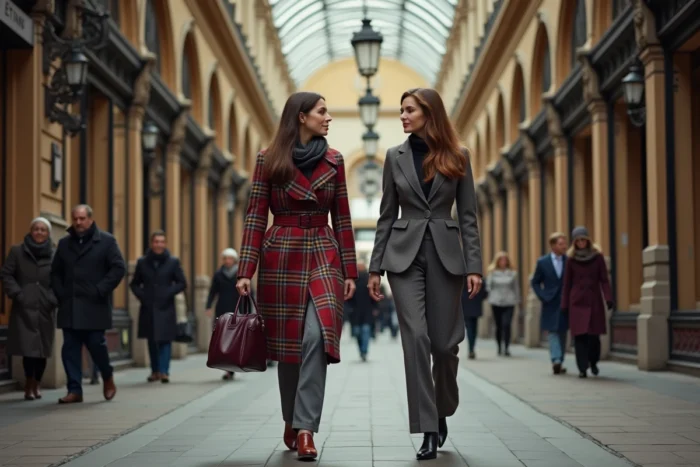
The chromatic base remains sober: navy, anthracite gray, beige, cream, olive green. These shades form the foundation on which a single accent is placed. This accent can be a pattern (Prince of Wales checks, houndstooth, chevrons) rather than a bright color.
The Prince of Wales check remains the most versatile pattern in the British wardrobe. Discreet from afar, it reveals its complexity up close. It can be found on trousers, suits, and certain scarves. It works in autumn as well as in winter without ever appearing dated.
The houndstooth, more graphic, is better suited for accessories or short pieces (skirts, vests) to avoid a total look effect. The chevron, on the other hand, structures coats and heavy jackets with a discreet elegance that plain tweed does not always offer.
Ultimately, British elegance comes down to a simple discipline: few pieces, materials that age well, a tailored fit, and a single character element per outfit. This wardrobe does not seek to impress. It seeks to endure, season after season, without ever appearing out of style.