
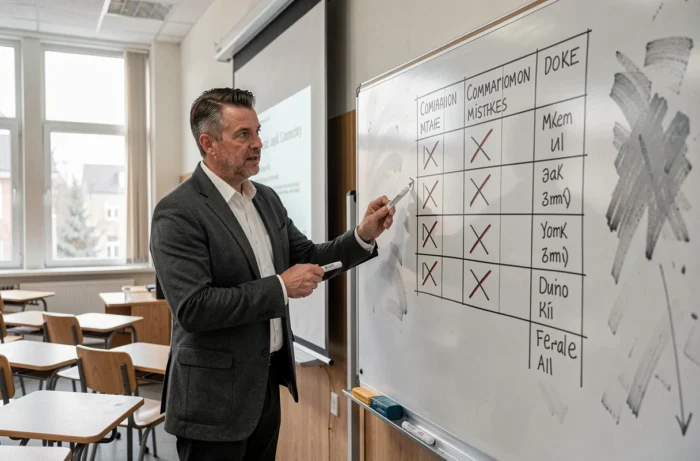
The majority of points lost on the characterization table do not stem from a lack of knowledge. We observe, copy after copy, the same slips: a criterion filled in the wrong column, a formulation too vague to be assessed, or a response that is unrelated to the provided document. This article targets the structural errors that examiners most frequently penalize.
Contextualization of the characterization table: the increasing demands of STMG subjects
Recent subjects have tightened a specific point: each criterion in the table must be explicitly linked to an indicator from the document. A student who writes “profit-oriented” without citing the passage from the document that proves it loses points, even if the answer is technically correct.
This requirement for contextualization transforms the table into a short argumentation exercise. It is no longer sufficient to restate a definition from the course; it must be connected to a tangible element: a revenue figure mentioned in the appendix, an excerpt from the statutes, a mission described in the text.
We recommend treating each box as a mini-demonstration in two parts: the named criterion using the program’s vocabulary, followed by the evidence drawn from the document. When a student has a good grasp of the STMG characterization table in its structure, they often remain trapped by this lack of documentary justification.
Legal status STMG: the most poorly filled box
Writing “private company” or “public organization” in the legal status box is the most common confusion. The legal status refers to the precise legal form: SA, SAS, SARL, EURL, association under the 1901 law, EPIC. Private or public pertains to the type of organization, not the status.
The problem arises from a shortcut sometimes taught in high school: classifying organizations as “private” and “public.” This classification is useful for understanding the purpose, but it does not replace the legal form. When the document mentions a company name containing “SAS” or “SARL,” this information must appear as is in the table.
Another recurring trap: confusing the company name and the trade name. If the subject mentions “Chez Paul,” but the statutes indicate “SAS Dupont Restauration,” it is the legal name that goes in the name box. The trade name can appear as a supplement, but never as a replacement.
Intangible resources in the STMG table: the forgotten category
The “resources” box is often filled with human and material resources, then left incomplete. Intangible resources are systematically overlooked, even though they constitute a differentiation marker expected by examiners.
Specifically, intangible resources cover elements that students know but do not think to classify in this category:
- The brand and reputation of the organization, cited in the document as brand image or notoriety
- Customer databases or management files, mentioned in the digital appendices of the subject
- Business software, patents, or operating licenses described in the company’s presentation
- Specific know-how, quality procedures, or certifications (ISO for example) mentioned in the documents
The omission of intangible resources is all the more penalizing as recent subjects often place explicit indicators in the document. A paragraph on “customer loyalty through CRM” or on “the notoriety gained over twenty years” calls for a mention in intangible resources. Failing to highlight it signals to the examiner a superficial reading of the document.
Purpose and sector of activity STMG: two criteria formulated too vaguely
A purpose is never limited to “making money.” The program expects a structured formulation: profit-oriented (seeking profit) or non-profit (public service, general interest, advocacy for a cause). The nuance matters. A mutual insurance company has a non-profit purpose even if it generates surpluses. An agricultural cooperative pursues an economic objective for its members without aiming for profit in the capitalistic sense.
The sector of activity poses a symmetrical problem. Answering “tertiary” is technically correct but insufficient. The examiner expects the concrete field of intervention: collective catering, IT consulting, retail food trade. This precision proves that the student has read the document and knows how to link the organization’s business model to its actual field of activity.
Size of the organization: a criterion that requires an indicator
Qualifying a company as “large” or “small” without supporting this classification with an indicator from the document results in lost points. Examiners expect a reference to the number of employees or the revenue mentioned in the documents.
If the document indicates a workforce or a range of revenues, it must be cited. If this data is absent, we recommend explicitly stating it rather than inventing an unfounded classification.

Method for reviewing the STMG characterization table
An effective review of the table relies on a cross-check between each filled box and the document. We recommend a three-point verification:
- Does each answer use the exact vocabulary of the program (profit-oriented, legal status, intangible resources) and not an approximate reformulation?
- Is each criterion linked to a specific element from the document (document number, cited passage, numerical data)?
- Do the boxes for name, legal status, and type of organization contain distinct information, without copying from one category to another?
This check takes a few minutes and is sufficient to eliminate most confusions between categories. The well-filled table is one where no box could be moved to another without creating an inconsistency.
The most costly trap remains the generic answer applicable to any organization. If a box in the table could equally apply to a bakery as to a public hospital, it lacks documentary precision. Each line of the table must unambiguously identify the organization studied, and nothing else.