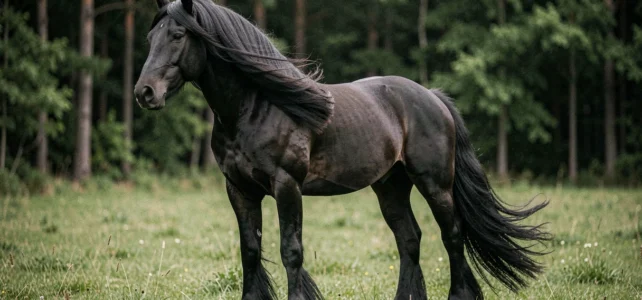
The Friesian is one of the oldest horse breeds in Europe, originating from the province of Friesland in the Netherlands. Its black coat, abundant mane, and elevated gaits make it an instantly recognizable horse. Behind this spectacular image, the breed is going through a pivotal period: genetic and health issues are now at the forefront, well beyond mere aesthetic considerations.
Friesian and Genetic Fragility: What the KFPS Alerts Reveal
The KFPS, the official stud book of the Friesian breed based in the Netherlands, published communications in July 2026 regarding the rising concerns related to serious hereditary conditions in Friesians. The topic has transcended the circle of breeders to reach national media coverage in the Netherlands.
Commonly cited anomalies include hydrocephalus, dwarfism, esophageal and stomach issues, as well as aortic rupture. These pathologies are consistent with a genetic origin linked to the bottlenecks the breed has experienced throughout its history.
A study conducted on Brazilian Friesians and published by the Fenway Foundation highlighted that the addition of new approved stallions does not necessarily broaden genetic diversity. If these stallions descend from the same founding lines, the genetic pool remains narrow despite the apparent increase in the number of breeders. This observation raises questions about the actual effectiveness of current selection programs.
Among French-speaking riders and breeders interested in the Friesian black horse breed, these health issues often remain unknown, overshadowed by the visual appeal of the animal.
Selection of Friesian Stallions: A Process Under Review
The KFPS initiated a formal reflection in 2026 on the overhaul of its stallion selection process through a dedicated working group (“Projectgroep Herijking Hengstenselectietraject”). The registration rules for Friesians are among the strictest in the equine world: purebred lineage is mandatory, and stallions are approved only after inspection of their gaits, movements, and conformation.
The tension lies between two objectives that are difficult to reconcile. On one hand, maintaining the morphological standards that define the Friesian. On the other, preserving sufficient genetic diversity to limit hereditary pathologies.
Field feedback diverges on this point: some breeders believe that the current selection criteria excessively prioritize aesthetics at the expense of robustness, while others argue that relaxing the standards would dilute the very identity of the breed. The available data do not allow for a clear conclusion that one model prevails over the other.
Black Coat and Baroque Gaits: The Criteria Defining the Friesian
The Friesian standard mandates an exclusively black coat. Only a small star on the forehead is tolerated. This chromatic requirement, combined with a particularly thick mane and tail as well as pronounced feathering, constitutes the visual signature of the breed.
Morphologically, the Friesian presents a so-called “baroque” model:
- A curved neck carried high, giving that characteristic silhouette in motion
- A rectangular body, with a deep chest and solid limbs suited to a horse of this size
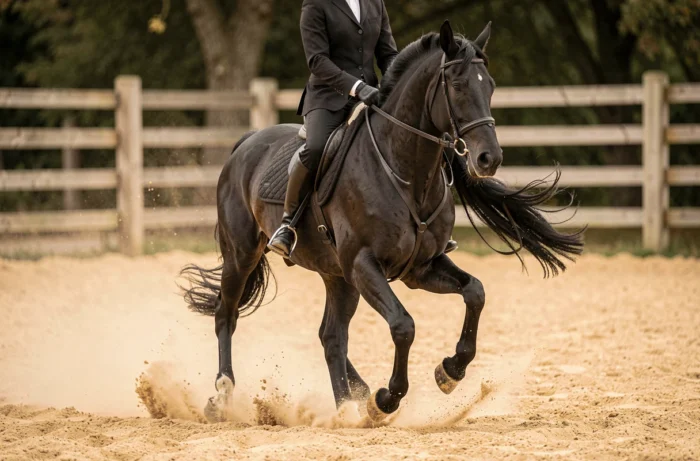
- Elevated and rhythmic gaits, particularly valued in dressage and driving
This type of conformation explains why the Friesian excels in disciplines where visual spectacle matters: academic dressage, traditional driving, equestrian shows, and cinema. In contrast, its morphology makes it less suited to speed or show jumping disciplines than lighter breeds like the Thoroughbred or Selle Français.
Dressage, Driving, and Show: Where the Friesian Truly Shines
The versatility of the Friesian is often emphasized, but it deserves to be nuanced. This horse finds its best expression in a specific register.
In dressage, its naturally rhythmic gaits and cooperative temperament make it a valued partner up to intermediate levels. High-level international competitions are still largely dominated by other breeds (KWPN, Hanoverians), whose movement mechanics better meet the current FEI judging requirements.
In driving, the Friesian has historically excelled. Its head carriage, power, and calmness make it a prestigious driving horse, used both in competition and official ceremonies.
- Classical and academic dressage: the Friesian’s preferred field thanks to its gaits and docility
- Traditional and competitive driving: the discipline where the breed has excelled for centuries
- Equestrian shows and cinema: its black silhouette and flowing mane make it the most photographed horse in the world
- Leisure riding: its human-friendly character suits riders looking for a calm partner
The temperament of the Friesian, often described as lively yet affectionate, contributes to its popularity among amateur riders. Its natural closeness to humans is a character trait that breeders actively select for.
Friesian Prices and Market: A Breed That Remains Accessible to Few Riders
The Friesian occupies the high end of the equine market. Acquisition costs are significantly higher than for most riding horses, due to the breed’s relative rarity outside the Netherlands and the strict requirements of the stud book.
Beyond the purchase price, the maintenance of a Friesian requires particular attention to weight control. The breed has a metabolic sensitivity that necessitates a forage-based diet, with monitoring of the risks associated with obesity. The abundant mane and feathering also require regular maintenance to prevent skin issues.
Friesians imported from the Netherlands represent the majority of the available subjects in France. The French market remains modest compared to North America, where the FHANA oversees the breed’s registration.
The Friesian captivates with a strong image, but the genetic and health realities documented by the KFPS remind us that this breed is undergoing a phase of deep questioning. For future buyers, checking the genetic status of a subject with the stud book before any purchase is no longer an option; it is a fundamental precaution.