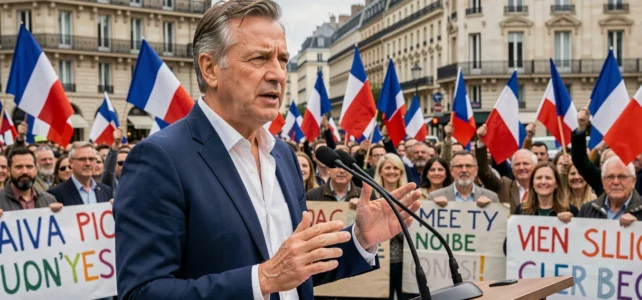
The Patriots, a party founded by Florian Philippot after his break with the National Front, occupy a unique political niche in the French landscape. Their stance is based on a strong sovereignty, articulated around leaving the European Union, returning to a national currency, and restoring controlled borders. Understanding their recent trajectory requires distinguishing between what pertains to media visibility and what reflects a real militant presence.
Radical Sovereignty: The Doctrinal Line of the Patriots in France
The ideological positioning of the Patriots stands out from other formations classified as right or far-right by its uncompromising stance on the European question. While the National Rally has gradually abandoned leaving the euro as a rallying cry, Florian Philippot maintains that leaving the European Union remains the only solution to rebuild France’s budgetary, monetary, and legislative sovereignty.
This position creates a narrow political space. It appeals to an electorate convinced that European institutions are irreformable, but it faces an electoral glass ceiling. Recent elections confirm this: in the Grand Est regional elections, Philippot did not make it past the first round. In the legislative elections, the party was marginalized in constituencies where the RN already captured the protest vote.
The news about The Patriots reflects this ongoing tension between a firm doctrinal line and electoral results that struggle to rise beyond a core of convinced militants.

Media Visibility of the Patriots vs. Electoral Presence
The central question for assessing the real weight of the Patriots lies in the gap between their media presence and their ability to convert this exposure into votes. Florian Philippot has successfully leveraged social media and video platforms to disseminate his positions, particularly during the health crisis when his protests against the health pass garnered attention.
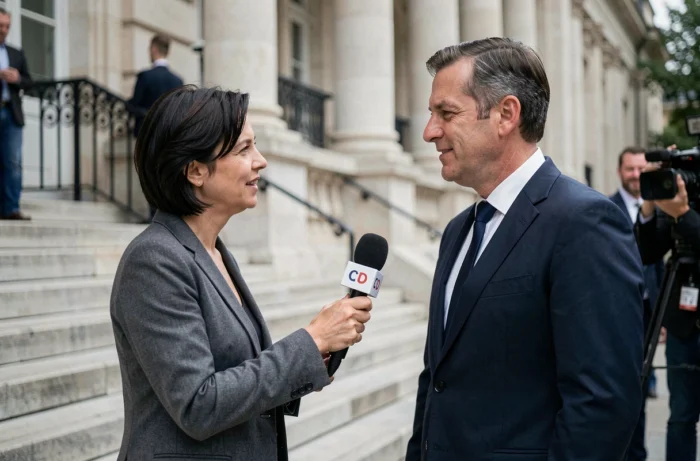
One episode illustrates this ambiguity well. LCI denied the existence of a demonstration organized by the Patriots before publicly apologizing. The incident reveals two things: the party generates enough media noise to provoke controversies, but its coverage remains polarized between militant outlets and mainstream media that often treat it from the angle of a news item.
The fragmented media treatment of the Patriots leaves little room for a factual assessment of their influence on the national political agenda. Video content and television appearances create an impression of dynamism that does not translate into votes.
What Electoral Scores Say About Militant Mobilization
Electoral results are the only objective indicator of implantation. In Forbach, Philippot’s historical stronghold, the RN significantly outperformed him in the legislative elections. This result is not anecdotal: it shows that radical sovereignty does not withstand competition from the RN on local ground, even in areas where Philippot has personal notoriety.
Militant mobilization is also measured outside of elections. The Patriots organize regular gatherings, broadcast online, that attract a loyal audience. The question is whether this base is renewing or contracting.
- In the Grand Est regional elections, the party did not reach the threshold for the first round, indicating an insufficient electoral base to weigh locally
- In the legislative elections, the direct competition from the National Rally reduced the available space for a dissenting sovereignist vote
- On social media, the audience remains significant but does not translate into massive memberships or local elected officials
Alignment of Right and Far-Right: Where Do the Patriots Stand
Recent political news highlights a growing alignment between the right and far-right on certain issues (immigration, security, sovereignty). Mediapart describes this dynamic as a structural symptom of the French political landscape, which goes beyond just the case of the Patriots.
In this context, Philippot’s party occupies a paradoxical position. Its sovereignist line is more radical than that of the RN, but it does not benefit from the mass effect provided by the militant apparatus and elected officials of the National Rally. The Patriots find themselves competing both with the RN on the electoral ground and with informal movements on social media.
The Patriots for Europe Group in the European Parliament
At the European level, the parliamentary group “Patriots for Europe” brings together MEPs from several countries, including the French delegation from the RN led by Jordan Bardella. This configuration creates frequent confusion: the European group is not Philippot’s party, even though both share sovereignist themes.
The French delegation of the Patriots for Europe group in the European Parliament includes MEPs from the National Rally, not from Philippot’s Patriots. This distinction is rarely made in media coverage, which fuels ambiguity about the party’s real weight in institutions.
Symbolic Actions and Controversies: The Media Fuel of the Patriots
The Patriots derive a significant part of their visibility from symbolic actions and controversial statements. Philippot declared that “the vital prognosis of France is at stake,” a phrase echoed on several platforms. This type of alarmist rhetoric serves a specific function: to maintain media attention between two electoral deadlines.
Protests against health measures constituted the peak of the party’s exposure. Since then, the challenge has been to find a new mobilizing theme capable of uniting beyond the historical militant core. Sovereignist statements on Europe or currency, while consistent with the party’s line, struggle to generate the same level of public engagement.
The strategy relies on a bet: that a major political or economic crisis will shift public opinion towards positions currently deemed marginal. In the meantime, the Patriots remain a party whose notoriety far exceeds its electoral base, an imbalance that defines both its media strengths and its concrete political limits.