
Rooms and Exits is based on a puzzle engine where each room combines items to collect, codes to decipher, and mechanisms to activate in a strict order. Understanding the recurring logic of the game allows players to unlock most levels without systematically resorting to an external guide.
Recurring Puzzle Mechanics in Rooms and Exits
The game by Webelinx Games structures its puzzles around three pillars: room exploration, item combination in the inventory, and the activation of sequential mechanisms. Each chapter revisits these pillars while varying the difficulty.
The order of interaction with objects determines the resolution of the level. A clue placed on a shelf only becomes readable after retrieving a light source from a locked drawer, which is accessible via a code found on an opposite wall. This cascading embedding explains why a player can get stuck for a long time on a seemingly simple step.
We observe that most blockages stem from an unexplored area rather than a misunderstood puzzle. The game engine regularly hides objects in corners of the room that are only accessible by a lateral swipe of the screen, to the left or right of the main view.
To find all the solutions for Rooms and Exits organized by chapter, it is essential to keep this logic of systematic exploration in mind before seeking the raw answer.
Code and Lock Resolution: Step-by-Step Method
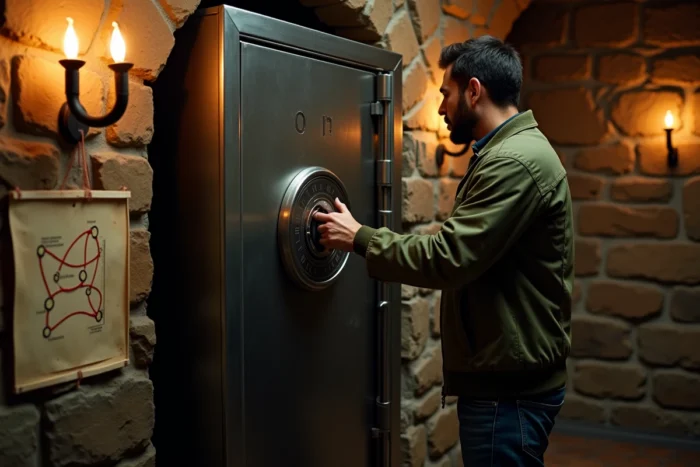
Code locks represent the most common type of puzzle in Rooms and Exits. Their resolution follows a reproducible pattern from one level to another.
Identify the Source of the Clue
Each lock is associated with a visual clue scattered throughout the room. This can be numbers engraved on objects, colors arranged in a specific order, or symbols to match. The code is never random; it always derives from a visible element in the room.
The difficulty increases as chapters progress. In the early levels, the clue and the lock are found in the same area. From the intermediate chapters (Murder Dressed in White, Pharaoh’s Bride), the clue may be fragmented across several rooms or require a prior transformation.
Apply the Correct Sequence
A classic trap is entering the right numbers in the wrong order. The game often imposes a specific reading:
- Reading left to right when the numbers are aligned horizontally on a wall or board
- Reading top to bottom for clues arranged vertically, for example on a column or a ladder
- Color-position matching when the lock uses colored segments instead of numbers
When a four-digit code refuses to work despite the correct elements, we recommend checking if a mirror or inversion is at play. Several levels in the Dark Waters series use this reflection mechanism.
Combinable Items and Inventory: Common Mistakes
Rooms and Exits allows the combination of items in the inventory, but this mechanic remains underutilized by most players. Selecting one item and then tapping on a second in the inventory can produce a new tool or reveal a hidden clue.
The advanced chapters multiply these combinations. A broken key combined with a piece of metal yields a functional key. An empty bottle filled at a water source becomes a solvent for cleaning a surface. The game does not explicitly indicate which items are combinable, leading to many blockages.
The current version of the game (distributed in version 2.59.1 on Android, requiring at least Android 7.0) has gradually added chapters whose combination complexity exceeds that of the early levels. Players on older devices, excluded by this system requirement, simply cannot access the latest content.
Chapters That Cause the Most Blockages and Why
Not all levels present the same difficulty. Some chapters concentrate unusual mechanics that trap even experienced players.
Pharaoh’s Bride introduces puzzles based on hieroglyphs whose reading logic differs from classic numerical puzzles. The player must match symbols to positions on a grid without an alphabetical reference, breaking with the habits acquired in previous chapters.
Death on the Dancefloor relies on sound and light clues. Muting the phone literally prevents solving certain puzzles, a detail that the game does not mention anywhere.
- Wicked Games: the first real increase in difficulty, with objects hidden in unintuitive areas
- No Honor Among Thieves: multiple inventory combinations required, none obvious
- Dark Waters: systematic mirror and inversion mechanisms on codes
- Murder Dressed in White: clues fragmented across several sub-areas of the room

Text or Video Solutions: Which Format for Which Blockage
Video guides show the exact manipulation but impose a linear viewing experience. For a player stuck on a single step, scrolling through several minutes of video to find the right passage remains impractical.
A structured text guide allows for precisely targeting the point of blockage. The player identifies the room, spots the relevant step, and obtains the solution without spoiling the rest of the level. This granularity explains why text solutions maintain their relevance against video walkthroughs.
The free-to-play model of Rooms and Exits, with its proprietary license and internal monetization, regularly pushes the player towards paid hints integrated into the game. A free external guide serves as a direct alternative to this commercial mechanic, which explains the constant demand for detailed and up-to-date solutions.
Rooms and Exits continues to add chapters at a steady pace. Each new content revisits the mechanics described here while complicating them. Mastering the logic of exploration, combination, and deciphering remains the best investment to approach each new level without a systematic dependence on solutions.