A mixed farming operator replacing their 120-horsepower tractor does not look at a catalog the same way as a cereal farmer equipped with 300 horsepower. The price displayed by the manufacturer almost never corresponds to the final amount, and the difference between two quotes for the same power can reach several tens of thousands of euros. Understanding how this price is formed helps avoid overpaying for equipment or, worse, under-sizing their investment.
Cost per hour of work: the real estimation criterion
There is a tendency to compare new tractors based on their face purchase price. In practice, this reflex leads to poor decisions. A cheaper tractor that consumes more or requires more frequent maintenance costs more per hour of work over five or seven years.
Since the sustained rise in diesel prices observed from 2021-2022, the fuel cost weighs as much as depreciation in the ownership cost of a self-propelled machine. It is no longer possible to accurately estimate the price of new agricultural tractors without factoring in hourly consumption, the cost of wear parts, and the estimated resale value at the end of the ownership period.
To reason in hourly cost, four items are added together:
- Annual depreciation, calculated on the difference between the purchase price and the residual value divided by the expected ownership duration
- Fuel, estimated based on the engine’s specific consumption and the number of hours worked per year
- Routine maintenance (filters, oils, tires, clutch) and unforeseen repairs
- The financial cost of the immobilized capital, whether purchased outright or on credit
This approach changes the hierarchy of offers. A Fendt or John Deere model priced higher than a competitor may turn out to be less expensive per hour if its consumption is lower and its resale value is stronger.
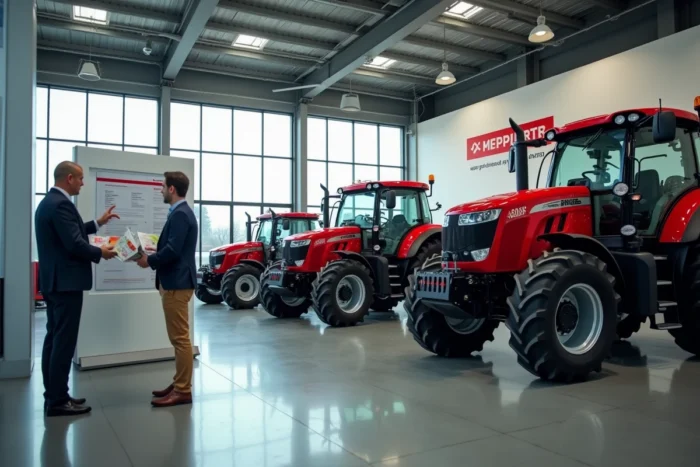
Difference between catalog price and actual price at the dealer
The catalog price of a manufacturer is a starting point, not a selling price. At the dealership, negotiation revolves around several levers simultaneously: commercial discount, trade-in of old equipment, financing conditions, maintenance package included or not.
The French market for new tractors experienced a notable contraction in 2024, with a decrease in registrations of about 10% for standard and specialized tractors over 50 horsepower. This drop in volumes pushes dealers to grant larger discounts on intermediate power levels to clear their stocks, a phenomenon that Cuma networks have started to relay.
In practice, it is observed that the margin for negotiation varies according to the brand’s positioning. Premium manufacturers (Fendt, Claas in the high-end) leave less latitude on the base price but offer more comprehensive service packages. Volume brands like New Holland or Massey Ferguson sometimes offer more direct discounts on the face price.
What the quote does not always reveal
A well-constructed quote details the price of the bare tractor, each option checked, the cost of commissioning, and delivery fees. Systematically asking for a line-by-line breakdown allows for comparing two offers on an identical basis. A front loader, an economical power take-off, or a GPS guidance system can each represent several thousand euros.
Feedback varies on this point, but some operators report discrepancies of over 15% between the first quote and the final price after negotiation on core market ranges.
Power, equipment, and transmission: the three variables that determine the price
Horsepower remains the primary determinant of price. The indicative ranges give an idea of the spectrum:
- A compact or low-power tractor (less than 100 horsepower) falls into a low range, accessible for specialized operations or livestock work
- The intermediate range (120 to 200 horsepower), the best-selling in France, concentrates the most competitive offers and the widest negotiation margins
- Beyond 250 horsepower, we enter the large-scale farming segment where prices rise rapidly with each additional power tier
The transmission plays a major role. A continuously variable transmission (CVT) adds a significant cost compared to a powershift gearbox but reduces operator fatigue and can decrease consumption in certain usage profiles. The choice of transmission influences both the price and the operating cost.
Embedded technologies (RTK guidance, telemetry, parcel management) inflate the bill but can pay off by reducing inputs and work time. The trade-off directly depends on the area farmed and the type of crops.

Electric tractors: a still marginal segment in budget estimation
The global market for electric agricultural tractors was valued at $155.6 million in 2023, a figure that remains very modest compared to the overall agricultural machinery market. The available electric models show prices significantly higher than those of thermal tractors of equivalent power.
For an operator estimating their new tractor budget in 2024, including electric options in the comparison only makes sense for low powers and very specific uses (market gardening, yard work). In the intermediate and high segments, thermal remains the pricing reference.
Concrete method for comparing two quotes for new tractors
Rather than looking at the total price at the bottom of the page, place the two quotes side by side, isolating five elements: the price of the bare tractor, the cumulative cost of options, the trade-in value proposed for the old equipment, the financing rate, and the warranty duration.
Bringing each offer to an annual ownership cost allows for neutralizing differences in commercial presentation. A more expensive tractor to purchase but with a long warranty and an included maintenance contract may turn out to be less costly than a competitor sold bare at a reduced price.
The last point to check remains the actual availability. In a contracting market, some models in stock benefit from favorable conditions, while custom configurations involve delays and sometimes a less favorable freeze on the catalog price.