
What criteria allow us to distinguish a sustainable decor trend from a fleeting fashion effect? Interior decoration in 2026 is no longer just about choosing a wall color or a sofa style. Technical, regulatory, and aesthetic developments are reshaping the available choices, and certain data should be compared before embarking on a project.
Chrome vs. Brass: Which Accent Metal to Choose for Your Interior
Brass has dominated interiors for several years, from door handles to lighting fixtures and plumbing. In 2026, chrome regains the advantage in high-end projects. This turnaround alters the visual coherence of an entire room, as accent metals often dictate the overall tone of a space.
Chrome offers a cooler, sharper finish that complements this year’s dominant color palettes (celadon, old rose, straw yellow). Brass, on the other hand, retains its relevance in warm-toned decors or bohemian atmospheres.
| Criterion | Chrome | Brass |
|---|---|---|
| Visual Finish | Cool, contemporary | Warm, vintage |
| Maintenance | Visible fingerprints, frequent cleaning | Natural patina over time |
| Color Compatibility 2026 | Celadon, old rose, cool tones | Straw yellow, terracotta, warm tones |
| Market Positioning | Dominant in high-end (2026) | Still present in mid-range |
The choice between these two finishes therefore depends as much on the color palette of the room as on the long-term maintenance budget. Mixing the two in the same space is generally discouraged by most interior designers: the coherence of metals visually structures a living room or kitchen much more than one might think.
To explore material and style combinations suitable for each room, Easy Home’s decor ideas allow for a quick visualization of what works well together.
European Regulation on Furniture: What Changes for the Consumer
A rarely addressed angle in decor articles concerns the regulatory constraints now placed on materials. In 2026, several European texts will significantly alter the available offerings in stores.
Formaldehyde, PPWR, and Product Digital Passport
The strengthening of formaldehyde requirements in particle board directly affects entry-level furniture. Manufacturers must reformulate their glues and resins, which impacts prices.
The PPWR regulation (packaging and packaging waste) imposes new constraints on the packaging of shipped furniture. The schedule for DPP/ESPR for furniture also plans for the gradual introduction of a product digital passport, requiring distributors to provide traceability and composition data.
For consumers, these developments mean two things:
- The cheapest furniture will likely see price increases, as compliance has a cost that manufacturers will pass on
- Material traceability will become a visible choice criterion, comparable to energy labels on appliances
- Wood sourced from “deforestation-free supply chains” becomes a verifiable selling point, rather than just a marketing claim
These constraints are not yet perceived by the majority of buyers, but they are restructuring the supply upstream.
Trending Colors 2026: Four Palettes and Their Uses by Room
The colors dominating this year share a common goal: they aim to create enveloping atmospheres rather than stark contrasts. Drenching (applying the same shade on walls, ceilings, and woodwork) illustrates this logic taken to the extreme.
Theatrical Red and Old Rose: Two Distinct Registers
Red is making a comeback in reception areas (living rooms, dining rooms) to create a dramatic effect. Old rose, on the other hand, finds its place in bedrooms and relaxation spaces. These two shades do not work in the same rooms and do not produce the same effect on the perception of volumes.
Red visually shrinks a space, making it suitable for large rooms where an intimate feeling is desired. Old rose, being lighter, maintains natural brightness and is suitable for modestly sized bedrooms.
Celadon and Straw Yellow: Brightness and Sophistication
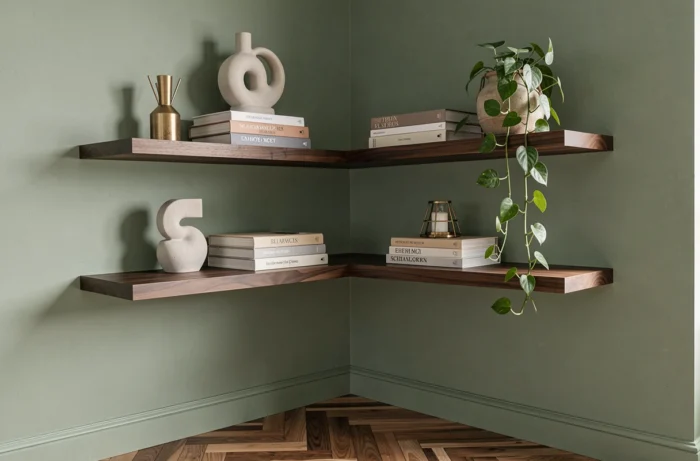
Celadon (grayish green with Asian inspiration) brings discreet sophistication to bathrooms and kitchens. Straw yellow, warmer, works well in north-facing rooms where natural light is lacking for part of the day.
End of the Residential Open Space: The Return of Partitioned Rooms
The open plan, which has structured interior layouts for over a decade, is receding. This evolution is presented as a change in the structure of housing, not just in decor palette. Architects are reintroducing partial walls, sliding doors, and visual separations between kitchens and living rooms.
The reasons are more functional than aesthetic: remote work has made it difficult to coexist with multiple uses (cooking, working, relaxing) in a single space. Noise, cooking odors, and the need for concentration have put an end to the all-open concept.
This return to partitioning changes the way decoration is thought about. Each room regains its own identity, with its color, lighting, and dedicated furniture. A living room no longer needs to “visually dialogue” with the adjoining kitchen.
AI and Decoration: Customization Accessible to Mid-Range Budgets
Artificial intelligence applied to decoration is no longer limited to Instagram filters. Layout projection tools now allow you to visualize a piece of furniture in your own space before purchase, or to test a wall color in augmented reality.
AI makes decorative customization more accessible to mid-range budgets. What previously required an interior designer (3D plans, mood boards, material selection) can now be partially automated. The nuance remains significant: these tools suggest combinations but do not replace the understanding of the physical constraints of a space (actual brightness, acoustics, circulation).
The choice of a decor style in 2026 is therefore made at the intersection of several parameters that go beyond mere personal taste. Regulatory constraints on materials, the return of partitioned spaces, and visualization tools alter the equation. The accent metal, the dominant color, and the very structure of the rooms form a whole to be considered simultaneously, not sequentially.