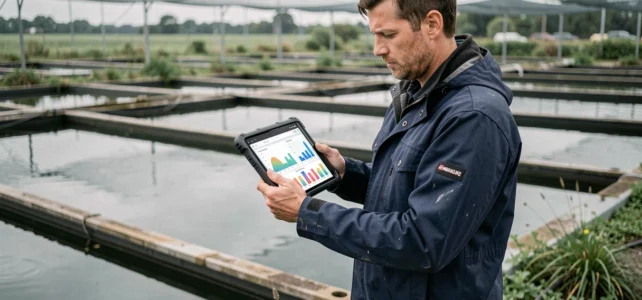
The French fish farming sector still largely relies on paper notebooks, scattered spreadsheets, and phone calls to track production, water quality, or sales. This situation contrasts with other agricultural sectors where digital tools have become established for several years.
The shift to a digital management system for a fish farming business raises practical questions: what data to centralize, how to adapt a tool to the reality of a pond or tank farm, and when the investment becomes profitable.
Real-time monitoring of water quality and production data
The first barrier to digitalization in aquaculture is not the cost of software, but the very nature of the data to be collected. Temperature, dissolved oxygen, pH, ammonia levels: these parameters vary continuously and condition the survival of the fish.
Recent digital solutions allow for centralizing water quality measurements on a single interface, with alerts in case of threshold exceedance. Some specialized mobile applications, such as Shrimpy for shrimp farms or Fish Farm Tracker developed for farms in Ghana, combine technical monitoring, economic management, and commercial connections in a single pocket tool.
This trend towards ultra-specialized applications by species or farm size reflects a need that general ERP systems do not cover: that of small and medium-sized farms that want to find information on My Fish Book or other platforms suited to their reality, without deploying a heavy infrastructure.
However, the reliability of this data directly depends on the quality of the installed sensors and their maintenance. A poorly calibrated sensor generates unnecessary alerts or, worse, masks a real problem. Digitalization does not eliminate the need for human control on the ground.
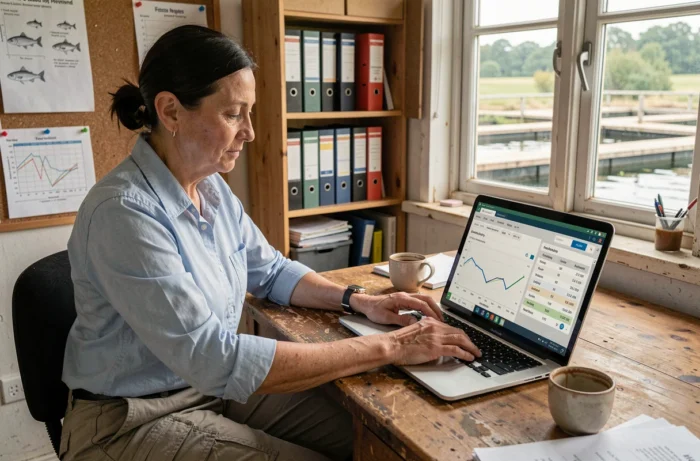
Integrated fish farming management: from pond to customer
Digitalizing production is not enough if the value chain remains fragmented. A farmer who tracks their water parameters on an app but manages their sales on a spreadsheet and their accounting on a third platform loses part of the expected profit.
Integrating production, stock, and sales data into a single system constitutes the real productivity gain. My Fish Book positions itself in this niche by offering fish farming companies a space that connects the technical management of farming to the marketing of products.
What an integrated platform for aquaculture covers
- Monitoring of farming cycles by pond or tank, with historical data on batches, mortality, and treatments applied
- Management of feed and input stocks, with automated calculation of feed/growth ratios
- Traceability of each batch from fry to delivery, meeting French and European regulatory requirements
- Connecting with buyers or distribution channels directly from the management tool
This type of integration avoids manual re-entries, a frequent source of errors. A fish farmer who records a harvest in their production module automatically sees their available stock updated on the commercial side.
Current limits of digitalization in fish farming
Field feedback diverges on one point: the adaptation time required for a farmer to actually use the tool daily. A high-performing software that remains underused because the interface is designed for an IT technician rather than for an aquaculturist solves nothing.
Connectivity poses another concrete problem. Many fish farms are located in rural areas where mobile network coverage remains weak. Applications that work exclusively online become unusable as soon as the signal disappears. Tools offering a offline mode with deferred synchronization better meet this constraint.
Cost and return on investment
The market for digital solutions for aquaculture is structured around two distinct business models. On one side, complete sector-specific ERPs target large structures with significant implementation budgets. On the other, subscription-based mobile applications target modest-sized farms.
For a small fish farm, the choice of tool depends on the production volume and the number of tanks to manage. A farmer with three ponds and short circuit sales does not have the same needs as an intensive operation covering several hectares supplying large retail.
The available data do not allow for a conclusion on a universal profitability threshold. The gain is measured differently depending on the operations: reduction of administrative time, decrease in losses due to poor water monitoring, or increase in revenue thanks to better marketing.
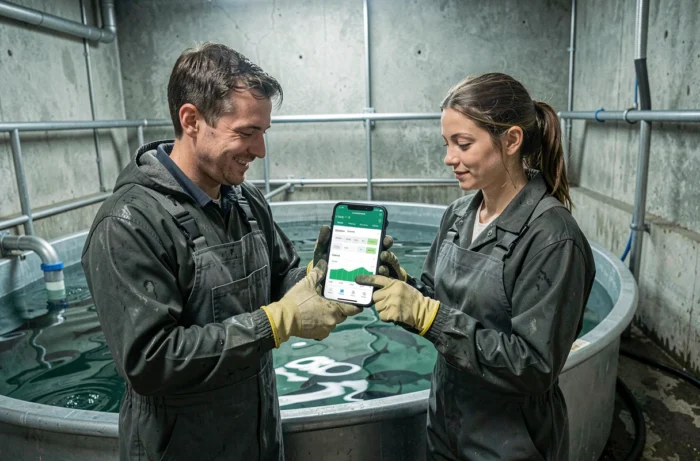
Traceability and regulation: what digitalization changes concretely
European regulations require aquaculture producers to ensure complete traceability of their products. Each batch must be traceable from the origin of the fry to the point of sale, including health treatments and farming conditions.
On paper, this obligation translates into bulky records and time-consuming checks during inspections. A digital tool like My Fish Book allows for the automatic generation of required documents from data entered throughout production.
- Health register continuously updated with automatic timestamps
- Exportable batch sheets in the format required by veterinary services
- History of water analyses available across multiple farming cycles
Regulatory compliance becomes a by-product of daily management rather than a separate administrative task. This point represents a concrete argument for farmers who spend several hours a month manually updating their records.
The digitalization of a fish farming business is not just about replacing a notebook with a screen. The real challenge lies in the ability of the chosen tool to adapt to the constraints of the field, whether it be connectivity, the diversity of species farmed, or the size of the operation. The solutions that will survive are those that understand that the aquaculturist needs an assistant, not a system to feed.