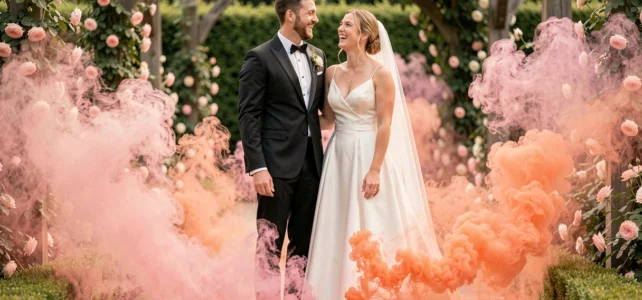
Wedding smoke bombs are not just a colorful cloud triggered randomly in front of a photographer. The effect depends on the type of product, its activation system, the burn duration, and increasingly, local regulations governing their outdoor use.
Chemical Composition and Activation Systems of Smoke Bombs
Three families of products coexist in the market. Handheld smoke bombs with a pin remain the most common for weddings. Mechanical pull activation releases a mixture based on potassium chlorate and organic dyes that produces dense smoke.
Impact smoke bombs work by ground impact, making them less suitable for a controlled staging. Friction models (striker) offer a more gradual trigger, useful when the photographer needs to synchronize the cloud with the pose.
We recommend systematically checking the burn duration indicated by the manufacturer. A model designed for around forty seconds leaves little room for adjusting a frame. Professional long-burning pots (several minutes) are better suited for posed photo sessions but generate a volume of smoke that complicates management in semi-enclosed spaces.
For everything you need to know about 123 Mariages and wedding smoke bombs, the selection offered covers these different categories with detailed technical sheets on each reference.
Prefectural Orders and Restrictions in Forest Areas
Most articles on wedding smoke bombs limit themselves to advising maintaining a safety distance and monitoring the wind. This approach ignores a very real tightening of territorial regulations.
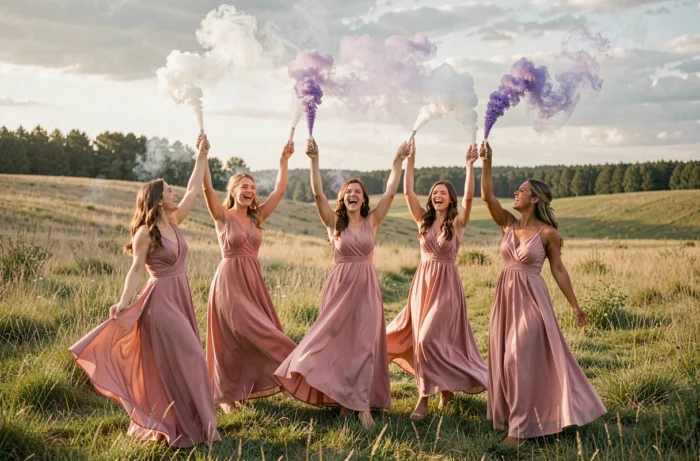
For several summers, departments with a forested landscape have published prefectural orders explicitly prohibiting the use of fire outdoors and transporting fire in areas exposed to fire risk. Smoke bombs fall under this prohibition.
In practice, a wedding shoot planned in a pine forest, a clearing, or on a beach bordered by dry vegetation may be illegal between June and September, depending on the current level of vigilance. The couple and the photographer risk a fine or even prosecution in the event of a fire outbreak.
- Check the website of the prefecture of the relevant department before planning the use of smoke bombs outdoors, verifying the current forest fire risk level.
- Prefer mineral locations (paved areas, gravel courtyards, parking lots) rather than vegetated spaces during the summer period.
- Have a backup plan without smoke bombs if the prefectural order moves to orange or red vigilance in the days leading up to the wedding.
This point is rarely addressed by service providers, even though it conditions the very feasibility of the desired effect.
Color Harmonization of Smoke with the Wedding Palette
The choice of smoke bomb color should not be made in isolation. Current wedding palettes incorporate very refined shades (terracotta, olive green, butter yellow) that imply a global visual coherence between decor, outfits, and visual effects.
A bright red smoke bomb in a wedding with powdery tones creates a visible chromatic break in every photo. Conversely, white or cream smoke integrates into almost all palettes and produces an enveloping effect without overpowering the colors of the clothing and decor.
We observe that couples working with an experienced photographer choose the color of the smoke bomb based on the expected light. Blue or green smoke looks better later in the day when the golden light compensates for the cold saturation. In bright midday sun, warm shades (pink, orange) appear washed out and lose their impact.
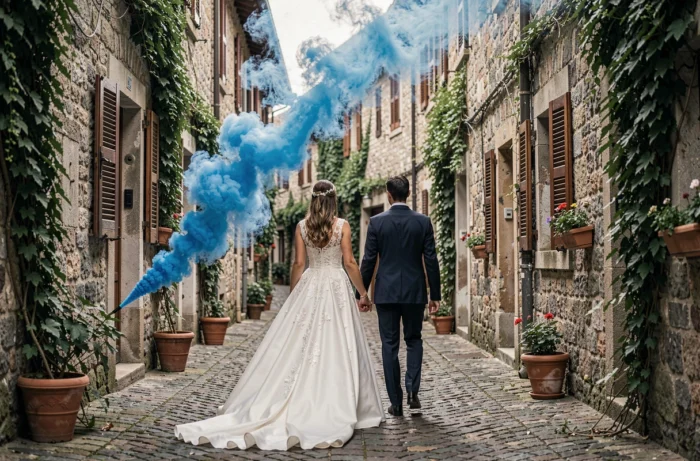
Wedding Smoke Bombs and Guest Comfort: Balancing the Effect
A recent trend pushes some couples to limit spectacular devices perceived as logistical constraints disguised as entertainment. Smoke bombs are among the effects that, if poorly calibrated, add pressure and timing without real benefit for the guests.
Smoke irritates the respiratory tract, stains light fabrics, and causes coughing fits in sensitive individuals. In a group of several dozen guests, the likelihood that at least one asthmatic person is present is high.
- Reserve smoke bombs for a targeted moment (ceremony exit, group photo) rather than multiplying them throughout the day.
- Inform guests in advance so that sensitive individuals can distance themselves.
- Position the smoke bombs downwind from the group, never in the middle of the crowd.
- Designate a responsible person for lighting and collecting residues to avoid burns and litter on the ground.
Confetti, cold fountains, or balloons remain viable alternatives when the venue or season makes smoke bombs too risky. The visual effect is different, but guest comfort benefits.
Which Smoke Bomb to Choose According to the Ceremony Moment
The church or town hall exit is the most photographed moment. A short-duration pin smoke bomb is sufficient, as the action unfolds in seconds and the couple moves quickly. A model that is too long continues to smoke after everyone has dispersed.
For the posed couple photo session, a long-burning pot allows the photographer to work from multiple angles without having to relight a new smoke bomb for each shot. The unit cost is higher, but the result justifies the investment.
The first dance indoors poses a specific problem. Smoke lingers under the ceiling, triggers detectors, and reduces visibility for the videographer. Heavy smoke machines (carbon dioxide) effectively replace smoke bombs in this setup, as the mist stays on the ground and dissipates without suspended residue.
The choice of product thus depends less on the desired color than on the location, the duration of the action, and the type of expected effect. A smoke bomb poorly suited to the moment spoils the scene instead of enhancing it.