
The outdoor unit of your air conditioner is running, and your neighbor closes their window. You turn up the volume on the TV to drown out the buzzing. The noise from an outdoor air conditioner is not just a temporary nuisance: since the law of April 15, 2024, abnormal neighborhood disturbance is included in Article 1253 of the Civil Code. A judge can now hold you liable without fault, based solely on the duration, repetition, and intensity of the noise perceived by the neighbor. Building a soundproof box for your outdoor air conditioner thus becomes both a legal and technical gesture.
Mass, airtightness, and ventilation: the trio that conditions the entire box
Before choosing your boards, you need to understand how sound travels through a wall. The noise from the air conditioner is a mix of mechanical vibrations (compressor, fan) and low frequencies that are difficult to block.
A lightweight panel, even if covered with foam, allows low frequencies to pass through. To attenuate them, mass is required. Good thickness MDF or plywood is more effective than a thin pine panel. The basic rule: the heavier the wall, the more it blocks low frequencies.
You may have noticed that a slightly open door lets in almost as much noise as an open door? It’s the same principle for a box. The slightest untreated gap ruins the acoustic insulation. Each junction between panels must be sealed with a soft seal (acrylic sealant or acoustic silicone), not just screwed together.
The outdoor unit of your air conditioner needs a continuous airflow to dissipate heat. A detailed guide on building a soundproof box for air conditioning emphasizes this often-overlooked point.
A box that is too closed causes the compressor to overheat and shortens the lifespan of the unit. Ventilation is not an option; it is a design constraint to be integrated from the start.
Designing the openings of the air conditioner box without ruining sound insulation
This is the technical point where most tutorials remain vague. Opening the box to allow air to pass through also opens a path for noise. The solution is based on a simple principle: force the sound to change direction.
The acoustic baffle applied to the air conditioner box
A baffle is a maze-shaped corridor placed in front of each opening. Sound travels in a straight line. When it has to turn one or two corners, it loses energy with each bounce. Air, on the other hand, flows easily through a bend.
In practice, you can build these baffles with scraps of the same wood as the box. Fix internal partitions that force the air to snake around. Line the inside of these corridors with acoustic foam: it absorbs mid and high frequencies at each passage.
- Provide a low air intake (natural intake of fresh air from the bottom of the box) and a high outlet (evacuation of hot air that rises).
- Each opening should have at least one 90-degree turn, ideally two, with internal walls covered in foam.
- Leave a space of at least fifteen centimeters between the air conditioner and any wall of the box to ensure efficient thermal exchange.
- Never place the hot air outlet facing a nearby wall: recycled air would raise the temperature around the outdoor unit.
Choosing insulation materials for the air conditioner soundproof box
A common mistake is to stack layers of foam thinking that thicker is better. In acoustics, it’s the combination of different materials that works, not the sheer thickness of a single one.
Wood panel and heavy acoustic mass
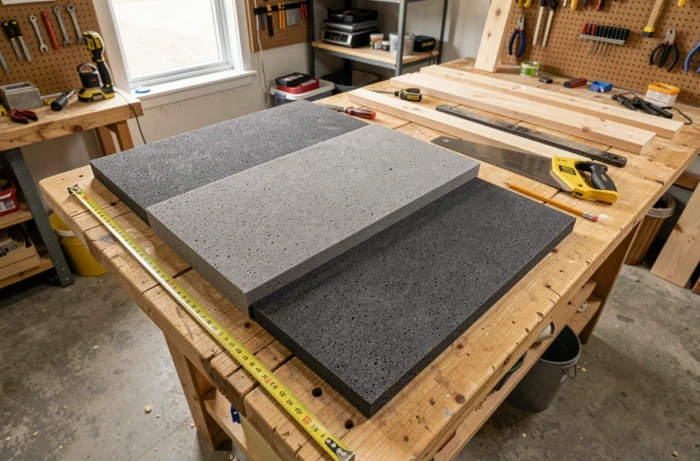
The outer structure of the box blocks sounds through its mass. MDF or marine plywood (moisture-resistant, which matters outdoors) forms the first barrier. Add a layer of heavy soft mass (sold in rolls at specialized acoustic stores) glued to the inner face of the wood. This dense and thin material significantly increases sound attenuation without thickening the box.
Acoustic foam and mineral wool
On top of the heavy mass, a layer of acoustic foam absorbs mid and high frequencies reflected inside the box. For the low frequencies from the compressor, dense rock wool as a complement yields better results than foam alone.
The order of the layers matters: wood (structure), heavy mass (blocking), porous absorbent (absorption). Reversing this order significantly reduces effectiveness.
Vibrational decoupling: addressing noise that the box does not block
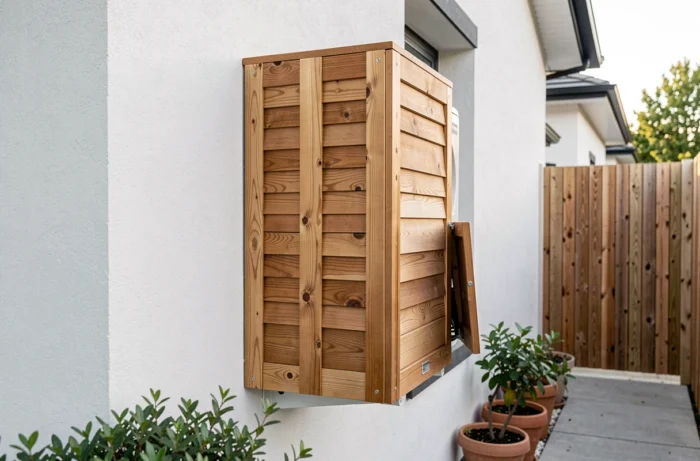
A perfectly acoustically insulated box can still transmit noise if the air conditioner vibrates against the floor or wall. These vibrations propagate through the building structure and emerge as dull noise inside the home, sometimes in the neighbor’s space.
Sound takes two paths: air (airborne noise) and solid materials (structure-borne noise). The box addresses the first, not the second.
- Place the air conditioner on vibration-damping pads or rubber anti-vibration mounts. These soft supports cut the transmission of vibrations to the slab or wall support.
- If the unit is wall-mounted, insert brackets with elastomer pads between the support and the facade.
- The box itself should not touch the air conditioner. Leave a free space all around. If the box rests on the ground, place it on soft pads to prevent it from becoming a resonating chamber.
Vibrational decoupling can reduce perceived noise more than the box itself in cases where the compressor transmits its vibrations through the floor.
Air conditioner noise regulation and neighborhood: what the box must really achieve
The threshold of 5 dB(A) of emergence found in many articles pertains to the public health code and neighborhood noise measured under specific conditions. In practice, the judge applying Article 1253 of the Civil Code is not bound by this threshold. They assess the disturbance as a whole: frequency of noise, operating hours, and sensitivity of the location.
A well-designed box, combined with vibrational decoupling, can significantly lower the perceived noise level. If your air conditioner is old and particularly noisy, the box alone may not always be sufficient.
In this case, replacing the outdoor unit with a newer, quieter model remains the most reliable solution. The box then serves as a complement to achieve a truly discreet noise level.