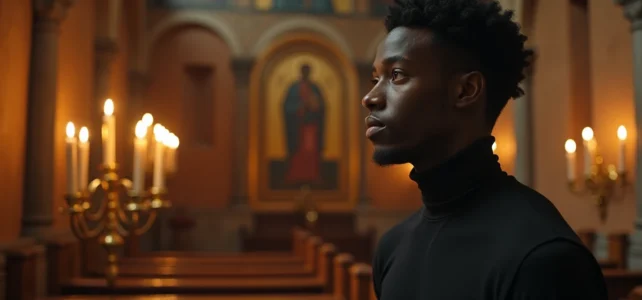
Abel Tesfaye, known as The Weeknd, grew up in Scarborough, east of Toronto, in a family of Ethiopian immigrants. His grandmother, who raised him for the most part, taught him Amharic as his first language and regularly took him to the Ethiopian Orthodox church. This religious foundation, rarely detailed in French-speaking portrayals of the singer, nonetheless structures a significant part of his artistic universe.
Ethiopian Orthodox Church and The Weeknd’s Childhood: A Rarely Decoded Heritage
The Ethiopian Orthodox Church is not just another form of Christianity. It is one of the oldest Christian churches in the world, with its own liturgical practices, fasting cycles, and calendar. For a child of the Ethiopian diaspora in Canada, the parish serves as a community landmark as much as a spiritual one.
Abel Tesfaye attended services, participated in religious celebrations, and was immersed in liturgical chants in Ge’ez, the sacred language of this Church. According to several analyses by fans and music critics, these sounds and this atmosphere permeate some vocal and melodic textures of his early projects.
An article dedicated to The Weeknd’s religion reminds us that this Orthodox dimension remains the starting point for any discussion about his beliefs, even if the artist has gradually distanced himself from it.
Does The Weeknd Still Define Himself as Believer: The Distance from Organized Religion
As his career has grown, The Weeknd has stopped presenting himself as a practitioner. Recent analyses of his spiritual journey describe a positioning that could be summarized as: spiritual by heritage, non-religious by adult choice.
This distinction matters. Abel Tesfaye does not renounce the Ethiopian Orthodox faith of his childhood, but he expresses distrust towards religious institutions and what he perceives as the rigidity of organized religion. The available data does not allow for a conclusion of a clear break or total rejection: it is more of a shift, a gradual distancing.
This positioning is not exceptional for an artist of his generation. However, what distinguishes The Weeknd is the way this tension between inherited faith and institutional rejection directly fuels his lyrics.
Religious Symbolism in The Weeknd’s Albums: Sin, Redemption, Fall
The Weeknd’s discography is permeated by recurring religious vocabulary. From the mixtape House of Balloons, references to sin, temptation, and a form of personal damnation structure the tracks. This is not gratuitous provocation: the narrative framework draws from the biblical fall.
Several elements recur from one album to another:
- The figure of the conscious sinner, who describes his excesses (drugs, destructive relationships) with a lucidity reminiscent of religious confession.
- The imagery of redemption, notably present in the transitions between After Hours, Dawn FM, and Hurry Up Tomorrow, where the character seeks a form of salvation after descending into hell.
- Visual references in the music videos and stage performances: crosses, light and darkness, the almost liturgical aesthetics of certain sets.
The trilogy After Hours, Dawn FM, and Hurry Up Tomorrow pushes this logic the furthest. Dawn FM stages a radio purgatory, a limbo where the protagonist’s soul is in transit. Hurry Up Tomorrow concludes this cycle with a more peaceful tone, as if the character reaches a form of inner peace, religious or not.
This vocabulary is not decorative. It gives The Weeknd’s music a narrative depth that many contemporary pop artists do not achieve, precisely because it draws from a concrete cultural experience rather than generic mystical clichés.
Accusations of Satanism and Fan Reactions: What Online Debates Reveal
On Reddit and other forums, some of the audience associates The Weeknd’s dark imagery with Satanism. These accusations focus on the visuals of certain music videos, the masks and bandages worn during the promotion of After Hours, and a few lyrical passages interpreted out of context.
No public statement from Abel Tesfaye supports this interpretation. Well-informed fan discussions consistently remind us that the singer’s dark aesthetic is an artistic choice, not a profession of faith. The confusion often arises from a misunderstanding of the narrative framework: describing sin does not equate to promoting it.
These debates illustrate a broader phenomenon. Any artist who uses religious vocabulary outside an explicitly devotional context exposes themselves to this type of over-interpretation. The Weeknd is no exception, especially since his refusal to publicly clarify his spiritual position leaves a space that everyone fills according to their own interpretations.
Ethiopian Heritage and Cultural Identity: Beyond Just the Religious Question
Reducing The Weeknd’s spirituality to the question of “believer or not” misses the essential point. For Abel Tesfaye, Ethiopian Orthodoxy is inseparable from a broader cultural identity: the Amharic language, the cuisine, the family codes of the Ethiopian diaspora in Canada.
The singer has repeatedly mentioned the influence of his grandmother and this culture on his personal development. The Orthodox heritage functions as an identity marker as much as a spiritual one. It nourishes his music not in the form of an explicit religious message, but as an emotional and aesthetic backdrop.
This nuance is largely absent from French-speaking media portrayals, which generally only mention the Ethiopian Orthodox confession without exploring what it concretely means in The Weeknd’s artistic journey. Religion here is a narrative thread, not a label.