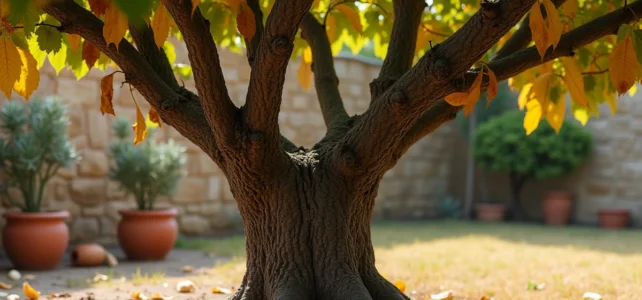
A fig tree whose leaves turn yellow and then fall sends a precise signal. The yellowing of the fig tree’s leaves almost always indicates an imbalance between the available water, soil quality, and the immediate environment of the tree. Before addressing anything, it is essential to understand what the tree is expressing.
Yellow leaves of the fig tree in autumn: false problem, true reflex
Have you noticed yellow leaves on your fig tree in September or October? The fig tree is a deciduous tree. Like the linden or apple tree, it naturally loses its foliage before winter. This seasonal yellowing corresponds to dormancy and signals neither disease nor deficiency.
The real problem begins when the leaves yellow in the middle of summer, between May and August. During this time, the tree should be in full growth. Summer yellowing indicates stress that the fig tree cannot compensate for on its own. This is when intervention is necessary.
When observing the yellow leaves of the fig tree in spring or summer, the first step is to identify the exact cause before applying any treatment. Both overwatering and drought cause yellowing, but the solutions are opposite.
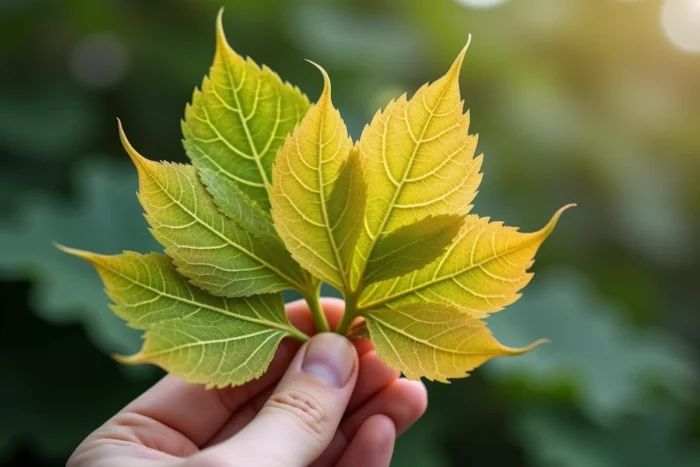
Water stress of the fig tree: too much or not enough water
Watering is the most common cause of yellowing. The fig tree has a often shallow root system that is very responsive to variations in soil moisture.
Lack of water: the fig tree sheds its leaves to survive
When the soil dries out deeply, the fig tree sacrifices part of its foliage to reduce evaporation. The lowest leaves turn yellow first, then fall. Fruits may also drop prematurely.
Shallow watering worsens the problem. Wetting the surface of the soil is not enough. Water must penetrate deeply, where the active roots are located. In compact or clayey soil, water runs off the surface without reaching the root zone.
The right method: water less often, but for longer. A drip system should run for several hours to be truly effective on a fig tree in the ground.
Excess water and poor drainage: asphyxiated roots
The opposite scenario is equally destructive. Saturated soil deprives the roots of oxygen. They begin to rot, the fig tree can no longer absorb nutrients, and the leaves yellow uniformly.
The distinctive signs of excess water:
- The leaves yellow all over the tree, not just at the base
- The soil remains wet or sticky several days after watering
- A rotten smell sometimes emanates from the base of the tree
- For a potted fig tree, water stagnates in the saucer
The priority correction is to improve drainage before any treatment. In pots, immediately remove any residual water in the saucer. In the ground, check that the planting area is not a basin where water accumulates after rain.
Herbicides and environmental shock: two less visible causes
When watering seems correct and yellowing persists, two avenues deserve exploration.
Sensitivity to root-absorbing herbicides
The fig tree has spreading roots that extend well beyond the projection of its crown. A chemical herbicide applied several meters from the trunk can reach these shallow roots. Nurseries specializing in fig trees report this factor as a recurring cause of unexplained yellowing.
Check if an herbicide has been used nearby, even on a path or neighboring flowerbed. If so, abundant watering to dilute the product in the soil remains the only realistic option.
Adaptation shock after transplanting or repotting
Have you just planted your fig tree, repotted it, or moved it? A sudden change in exposure (from shade to full sun, temperature variation) causes adaptation stress. The tree may lose some of its leaves while it acclimates.
This post-move yellowing is temporary. If the new shoots remain green, the tree is recovering. Avoid compensating with excessive watering, which would worsen the situation.

Soil diagnosis before treatment: the concrete method
The common reflex is to water more as soon as the leaves turn yellow. This approach fails in the majority of cases because it does not take into account the actual state of the soil below the surface.
Before modifying anything, perform this simple test: push a finger or stick about ten centimeters below the surface. A dry surface soil can remain moist deeper down, and vice versa. It is this deep moisture that determines whether your fig tree is lacking water or has too much.
If the soil is dry deep down, water slowly and thoroughly. If it is moist or waterlogged, stop all watering and work on drainage. This check takes thirty seconds and avoids the most common mistakes.
For a potted fig tree, the substrate must allow water to drain freely. A mixture that is too compact retains moisture around the roots and promotes rot. Add coarse sand or perlite if water takes too long to pass through the pot.
Fungal diseases and pests of the fig tree: when to suspect a fungus
If watering and drainage are correct, and no herbicide has been used, yellowing may have a pathological origin. Fig rust, caused by a fungus, manifests as yellow then brown spots on the upper side of the leaves, with orange pustules underneath.
The black fig fly can also weaken the foliage by laying its eggs on the fruits and branches. The leaves do not yellow directly, but the tree loses overall vigor.
Fungal treatments are only justified after eliminating environmental causes. A well-watered fig tree, in well-drained soil, with appropriate exposure, naturally resists most diseases. Correcting the environment before chemically treating remains the basic rule for this robust Mediterranean tree.
The fig tree tolerates heat, moderate drought, and poor soils. Its yellow leaves are rarely a sign of a serious disease. In the vast majority of situations, an adjustment of watering and drainage is enough to stop leaf drop within a few weeks.