
You buy an apartment, furnish it, and rent it out. The rents collected are declared not as property income, but as industrial and commercial profits (BIC). This tax shift changes the entire equation regarding the net profitability of a rental investment. The LMNP status, for non-professional furnished rental, is based on this simple principle, but its practical implications deserve attention.
Reintegration of depreciation upon resale: the tax trap from 2025
Most LMNP guides emphasize the depreciation of the property under the real regime. This mechanism allows you to deduct a fraction of the purchase price, furniture, and renovations each year. During the rental phase, this significantly reduces, or even eliminates, the tax on rents.
Where the situation has changed: depreciation is now reintegrated into the calculation of the capital gain upon resale. Before 2025, an investor could depreciate their property over ten years and then sell it benefiting from the capital gains regime for individuals without these depreciations being taken into account. This is no longer the case.
In practical terms, if you have depreciated several tens of thousands of euros during the holding period, this amount increases the taxable capital gain at the time of sale. To delve deeper into real estate investment on Bâtir Architecte, this point is detailed with practical cases illustrating the real impact on exit taxation.
This rule does not make the LMNP under the real regime uninteresting. It requires thinking about the complete investment cycle, not just the rental phase.
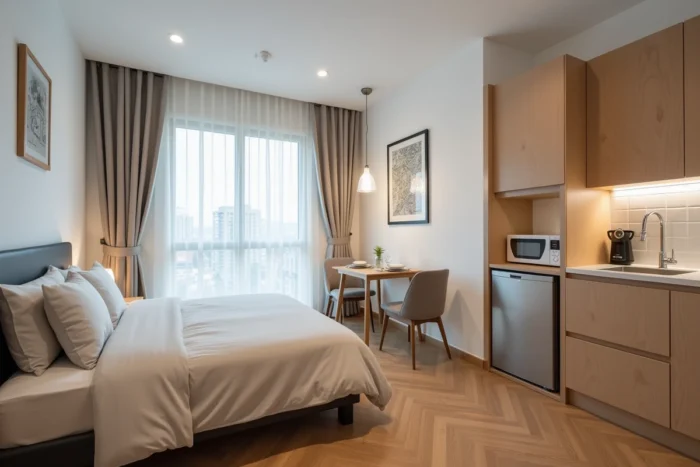
Micro-BIC regime or real regime in LMNP: arbitration based on the type of rental
Two tax regimes coexist for declaring your furnished rental income. The choice between the two depends on the profile of the property and the amount of your actual expenses.
Micro-BIC: simplicity and flat-rate deduction
The micro-BIC regime applies a flat-rate deduction on the rents received. You declare the gross amount, the administration automatically deducts the allowance, and you are taxed on the remainder. This regime is suitable when actual expenses (loan interest, renovations, insurance, management) remain low compared to rents.
Note: the law of November 19, 2024, tightened the deduction for unclassified tourist rentals. Unclassified short-term rentals lose part of their tax advantage under micro-BIC. If you rent a classic furnished property for the year, the regime remains stable.
Real regime: deduction of expenses and depreciation
The real regime allows for the deduction of all actual expenses and depreciation of the property. It requires rigorous accounting, often maintained by an accountant or specialized software. This is the regime that generates the most tax savings when expenses exceed the flat-rate deduction amount of micro-BIC.
For an apartment purchased on credit with renovation work, the real regime often reduces taxation to zero for several years. The downside, since 2025, is the reintegration of depreciation upon resale.
Registration and declaration of LMNP activity: the concrete formalities
Before receiving the first rent, an administrative step conditions everything else. You must declare the start of your furnished rental activity via the INPI’s single window, within fifteen days after the first day of rental.
This process results in the assignment of a SIRET number. You choose your tax regime (micro-BIC or real) at this time. Here are the points of vigilance:
- The fifteen-day deadline is strict: a late declaration can lead to complications for the tax attachment of the first year.
- The choice of the real regime must be explicitly stated during registration; otherwise, micro-BIC applies by default.
- A dedicated bank account is not mandatory, but it simplifies accounting and reduces the risk of error in case of a tax audit.

LMNP threshold and risk of switching to LMP
The LMNP status imposes two cumulative conditions: annual rental income must remain below the legal threshold, and it must not exceed other professional income of the tax household. If either of these conditions is no longer met, you switch to professional furnished rental (LMP).
The transition to LMP significantly changes taxation, particularly on social contributions and the treatment of capital gains. This is not a disaster in all cases, but it is a change that should be anticipated, not endured.
VAT and para-hotel services: a boundary to watch
You rent a furnished dwelling without services: no VAT. You provide at least three of the four hotel-type services (breakfast, regular cleaning, linens, reception): the activity falls under VAT. This boundary is stricter than it seems and can challenge the exemption usually associated with residential furnished rentals.
Legal structure for purchase: co-ownership or family LLC
Do you want to invest together, as a couple or among partners? The common law SCI that rents furnished automatically switches to corporate tax and loses the LMNP regime. Two alternatives preserve the status:
- Co-ownership, which maintains the classic LMNP regime for each co-owner, with sometimes more burdensome management in case of disagreement.
- The family LLC, reserved for members of the same family, which retains the tax regime of furnished rental while legally structuring the ownership of the property.
- Purchasing in one’s own name remains the most straightforward solution for a sole investor, with no additional formalities beyond registration at the single window.
The choice of structure depends on the number of investors, the family relationship between them, and the intended transmission strategy. A poor choice of structure can cost more than the tax gain of the LMNP itself.
Investing in LMNP remains an effective lever for generating rental income with controlled taxation. The rules have evolved, particularly regarding resale and tourist rentals. Calibrating your tax regime, declaring your activity on time, and choosing the right legal structure from the start: these three decisions condition the actual profitability of the project throughout its duration.